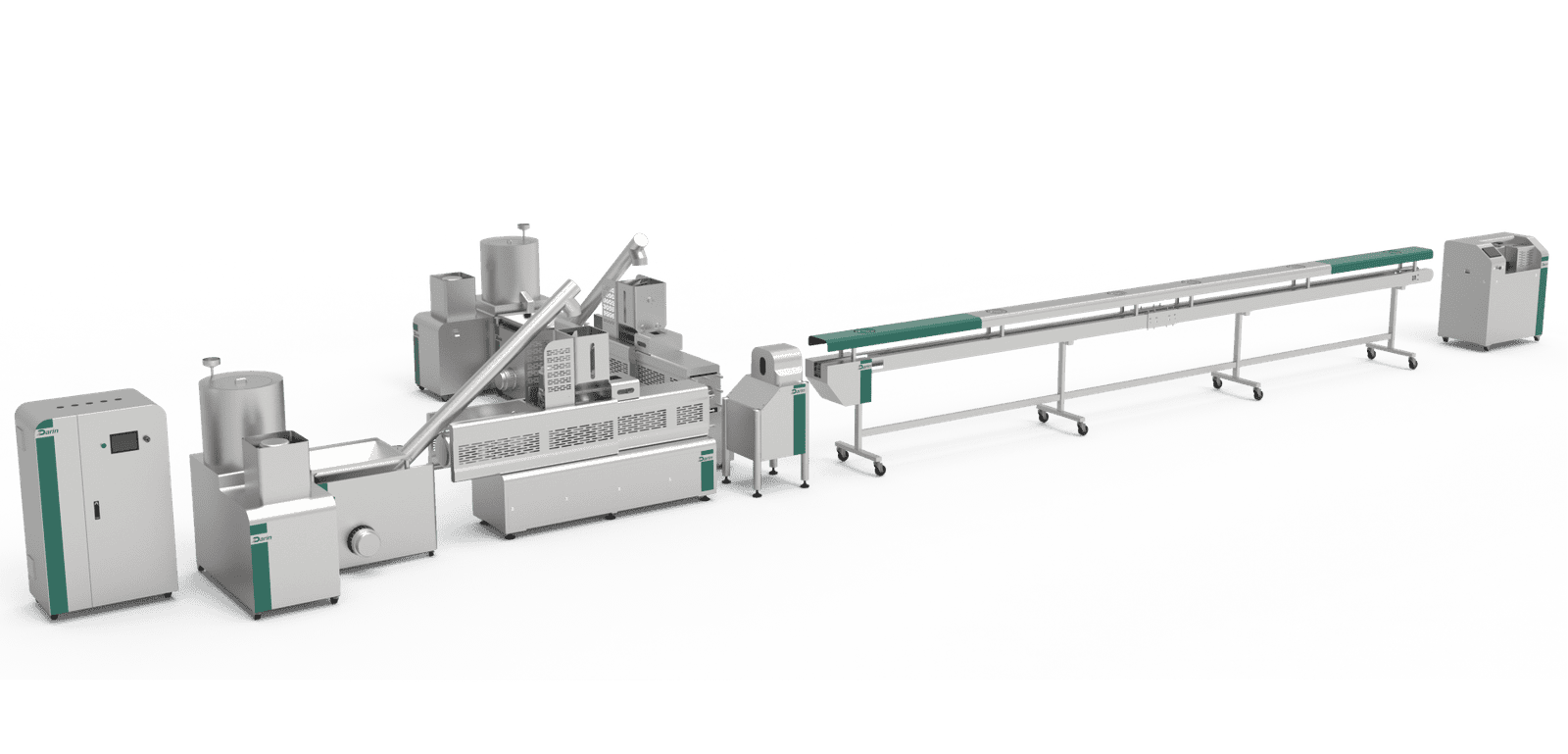
Pet dental skewer treats combine multiple ingredients or flavors into a single chew product. For pet treat manufacturers, producing these treats at scale can involve several labor-intensive operations, including forming, skewer assembly, tray loading, drying, cooling, and product unloading.
In a manual production setup, workers handle many of these tasks individually. As production demand increases, manufacturers may face challenges with labor availability, production scheduling, product consistency, and coordination between processing stages.
An automatic pet skewer treat production line offers an alternative by integrating key operations into a coordinated workflow. Darin Machinery's DR-S4 triple-flavor pet dental skewer production line is designed to automate forming, drying, cooling, and unloading, helping manufacturers move toward a more integrated production process.
So, what actually changes when a factory moves from manual production to an automatic line? The answer involves more than the number of workers on the production floor. It also concerns how materials move through the factory, how production stages are coordinated, and how finished products are managed.
1. Manual Pet Skewer Production: Where Are the Bottlenecks?
Manual production can be suitable for small-scale operations or manufacturers with limited production requirements. However, several challenges may emerge when the factory needs to increase output or maintain a more predictable production schedule.
Labor-Intensive Forming and Skewer Assembly
Manual production may require workers to handle individual product portions, assemble the skewers, and arrange the products for subsequent processing.
These tasks involve repeated hand movements and require workers to maintain a consistent working speed. Production capacity can therefore depend heavily on the number of available workers, their experience, and the organization of the production area.
When order volumes increase, manufacturers may need additional workers or longer operating hours to meet delivery schedules.
Repeated Tray Loading and Material Handling
In a production process where each operation is managed separately, workers may need to transfer products between forming, tray loading, drying, and unloading stages.
These additional handling steps require time and coordination. They can also make production planning more complicated when different stages operate at different speeds.
For manufacturers seeking to scale up, the challenge is not simply to accelerate one operation. The complete workflow needs to be considered.
Product Consistency and Quality Control
When products are assembled manually, differences in portion size, ingredient placement, and skewer alignment may occur.
The final result also depends on raw material characteristics, forming conditions, drying parameters, and handling practices. Variations at an early stage can affect the appearance and condition of the finished product.
Mechanized forming can help standardize defined production operations, although finished product consistency still requires appropriate process settings and quality-control procedures.
Labor Availability and Production Planning
Repeated manual tasks can make staffing a significant part of production management.
Worker absences, staff turnover, training requirements, and changes between shifts may affect the continuity of manual operations. Manufacturers handling larger orders may find it difficult to expand production quickly without increasing their staffing requirements.
These challenges explain why some pet treat manufacturers consider integrating their production processes rather than continuing to manage every operation separately.
2. Manual vs. Automatic Pet Skewer Treat Production: What Changes?
The main difference between manual and automatic production is how much of the process is performed through coordinated machinery rather than individual manual operations.
| Production factor | Manual production | Automatic production |
|---|---|---|
| Forming and assembly | May require repeated manual handling and assembly | Mechanized forming and product processing according to the selected configuration |
| Tray loading and unloading | Workers handle products and trays manually | Designed to reduce manual handling through integrated processing and automatic unloading |
| Production continuity | Depends partly on staffing and manual work speed | Equipment coordinates key operations during production |
| Product consistency | Can vary with worker technique and handling | Mechanized operations can help standardize defined processing steps |
| Labor requirements | More workers may be needed for repetitive operations | Fewer workers may be required for the automated stages |
| Production coordination | Separate operations may require frequent transfers and manual coordination | Connected processing stages support a more organized workflow |
| Production expansion | May require additional workers, workstations, or operating hours | Capacity planning can be based on line performance and operating requirements |
The actual difference depends on the starting production process, product specifications, equipment configuration, and operating conditions. Automation does not eliminate every manual task, and manufacturers should evaluate the complete production line rather than comparing individual machines in isolation.
For a factory producing triple-flavor pet dental skewers, the practical objective is to reduce repetitive manual work while coordinating the main processing stages more effectively.
3. How Does an Automatic Pet Dental Skewer Production Line Work?
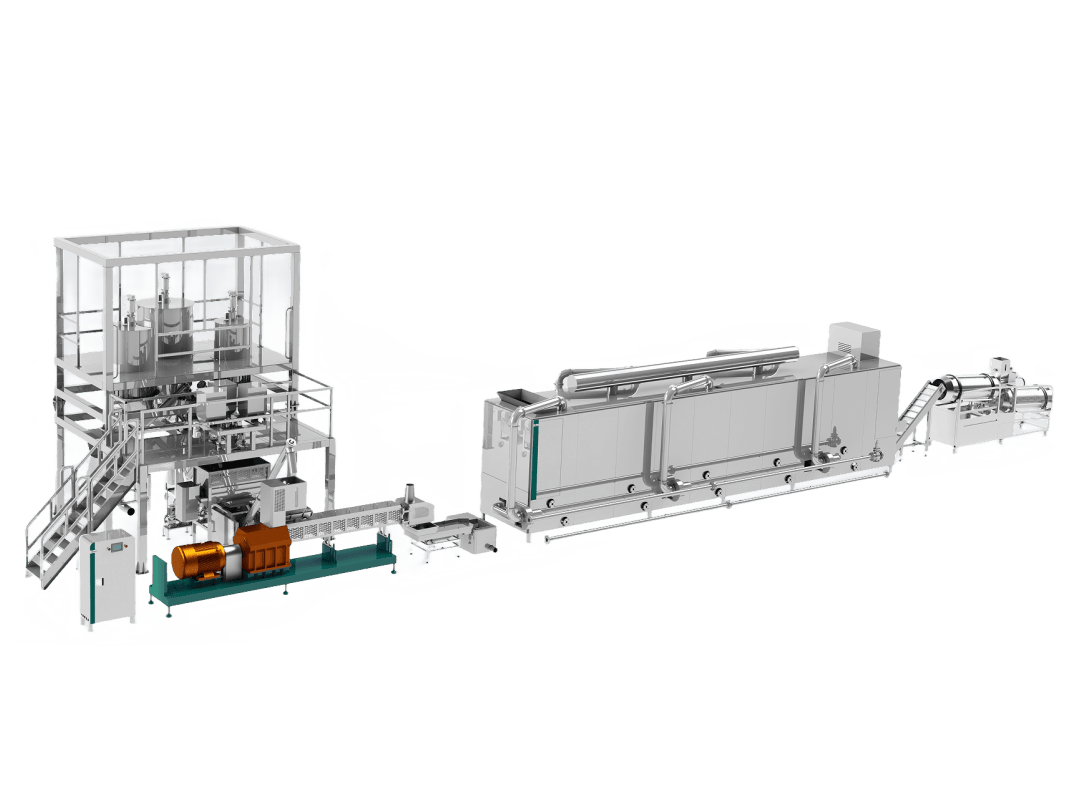
An integrated pet dental skewer production line connects several key operations. In the Darin DR-S4 configuration, the main systems include forming, drying, cooling, and automatic unloading.
3.1 Forming System: Producing Triple-Flavor Pet Dental Skewers
The forming system processes the raw materials into the required skewer treat shape. For triple-flavor products, the forming process is intended to combine the specified ingredients or flavors into the desired product structure.
Mechanized forming can help control product dimensions and portion consistency according to the machine settings and material characteristics.
For manufacturers, this stage is important because the shape and structure of the formed product influence subsequent drying and handling requirements.
The appropriate configuration should be confirmed according to the recipe, material properties, target product dimensions, and required production output.
3.2 Drying System: Reducing Moisture and Developing Product Structure
After forming, the products enter the drying stage.
Drying reduces moisture content and helps develop the required finished product characteristics. Temperature, drying time, airflow, loading conditions, and product dimensions can all influence the result.
For pet treat manufacturers, the objective is to establish drying conditions that are appropriate for the specific product and its storage requirements.
An integrated production line helps organize the movement of products through the drying stage. However, manufacturers should validate drying parameters for their own formulations and target specifications rather than assuming that one setting is suitable for every product.
3.3 Cooling System: Preparing Products for Unloading
Products coming out of the drying stage may still be warm and require cooling before subsequent handling.
The cooling system lowers product temperature and prepares the treats for the unloading stage. Appropriate cooling helps manage product handling conditions and can reduce problems associated with handling products while they are still hot.
The required cooling conditions depend on the product structure, temperature after drying, and the selected equipment configuration.
Connecting cooling with the preceding and following stages helps organize the overall production workflow.
3.4 Automatic Unloading: Reducing Repetitive Manual Work
Once the products have passed through the necessary processing stages, they need to be removed from their tooling carriers.
Automatic unloading is designed to remove the finished products from these carriers, reducing the need for workers to perform the same removal operation repeatedly.
Depending on the factory's requirements and selected configuration, additional modules can be considered for:
- Automatic product sorting
- Product counting
- Packaging
These functions should be confirmed as part of the equipment configuration. Sorting, counting, and packaging are optional modules rather than guaranteed standard functions of every line.
By connecting forming, drying, cooling, and unloading, manufacturers can move away from managing each stage as an isolated operation and toward a more coordinated production process.
4. Darin DR-S4: An Integrated Solution for Triple-Flavor Pet Dental Skewers
Darin Machinery provides pet food and pet treat processing equipment for manufacturers developing automated production workflows.
The DR-S4 is designed for triple-flavor pet dental skewer production, combining the main processing stages into an integrated line.
Its documented specifications provide a starting point for manufacturers evaluating whether the equipment fits their production requirements.
DR-S4 Technical Specifications
| Parameter | Specification |
|---|---|
| Model | DR-S4 |
| Product application | Triple-flavor pet dental skewer treats |
| Production capacity | 4,000 pieces/hour |
| Installed power | 5 kW |
| Standard power supply | 380 V / 50 Hz, three-phase |
| Custom power supply | Other voltage configurations, such as 415 V or 480 V, subject to confirmation |
| Approximate line length | 18–20 m |
| Approximate line width | 2.5 m |
| Suggested factory space | Approximately 22 m × 3 m or larger, allowing for maintenance access |
| Suggested staffing | 1–2 people per shift for feeding, monitoring, and inspection |
| Main processing stages | Forming, drying, cooling, and automatic unloading |
| Optional modules | Sorting, counting, and packaging, depending on configuration |
| Control system | PLC-controlled production line |
These figures describe the documented DR-S4 configuration. The production capacity is a stated equipment specification, not a guarantee of sustained output under every operating condition.
Actual output can vary with product dimensions, material characteristics, operating parameters, downtime, and production management. The required staffing level also depends on the amount of manual feeding, inspection, material handling, and optional downstream equipment.
Before purchasing, manufacturers should confirm the complete technical configuration and applicable production conditions with Darin Machinery.
How Does the DR-S4 Change the Production Workflow?
The main objective of the DR-S4 is to coordinate the key production stages rather than simply increase the speed of one machine.
For a factory currently relying on manual assembly and handling, the line offers a way to mechanize defined operations and reduce repetitive work.
The intended workflow is:
Forming → Drying → Cooling → Automatic Unloading
Optional sorting, counting, and packaging modules can be evaluated when the factory needs additional automation after unloading.
This approach allows manufacturers to assess automation as a production system, taking into account how each stage connects to the next.
5. What Should Manufacturers Consider Before Automating?
An automatic production line is not automatically the right solution for every factory. The decision should be based on production requirements, existing bottlenecks, and the expected role of the equipment in the wider manufacturing process.
Define the Required Product Specifications
Start by identifying the required skewer shape, product dimensions, ingredient formulation, and finished product characteristics.
Triple-flavor products may have specific forming and material-handling requirements. These should be discussed before confirming the equipment configuration.
Establish a Realistic Production Target
Manufacturers should estimate their required output per hour, shift, and day.
The DR-S4 has a stated capacity of 4,000 pieces per hour, but actual production performance needs to be evaluated against the intended product and operating conditions.
It is also important to distinguish between the machine's stated capacity and the number of saleable products produced during a complete production shift.
Evaluate the Drying Requirements
Drying is an important part of pet treat manufacturing. Different formulations, product dimensions, and target moisture levels may require different processing conditions.
Before finalizing the line, manufacturers should confirm the appropriate drying parameters and assess whether the proposed configuration meets the product's requirements.
Check Factory Space and Utilities
The DR-S4 has an approximate line length of 18–20 m and a width of around 2.5 m.
The factory should also allow space for operator access, maintenance, material supply, and any required upstream or downstream equipment.
The standard electrical specification is 380 V / 50 Hz, three-phase power. Manufacturers operating in other markets should confirm the required electrical configuration before ordering.
Calculate the Complete Cost of Production
The investment decision should consider more than the equipment purchase price.
Relevant factors include:
- Equipment investment and installation
- Labor requirements before and after automation
- Electricity consumption
- Maintenance and spare parts
- Production downtime
- Material waste and finished-product quality
- The expected utilization rate of the line
A realistic assessment compares the existing production process with the proposed automated workflow using the factory's own operating data.
This helps manufacturers determine whether the expected operational benefits justify the investment.
6. Is Automatic Pet Skewer Production Right for Your Factory?
An automatic pet dental skewer production line may be worth evaluating if your factory:
- Currently depends on manual skewer assembly, tray loading, or product unloading.
- Experiences labor shortages or difficulties maintaining a consistent production schedule.
- Wants to coordinate forming, drying, cooling, and unloading within one production workflow.
- Produces triple-flavor pet dental skewers and needs a defined production capacity.
- Plans to expand production without relying entirely on additional manual work.
- Wants to assess optional sorting, counting, or packaging automation.
For factories with small production volumes or highly variable product specifications, a partially automated setup may also be worth considering.
The most suitable solution depends on the factory's product range, existing process, available space, production targets, and budget. A technical assessment is therefore an important step before confirming the final equipment configuration.
7. Pet Treat Production Line Solutions from Darin Machinery
Darin Machinery provides pet food and pet treat processing equipment, with solutions designed around manufacturers' production requirements.
For triple-flavor pet dental skewer production, the DR-S4 integrates forming, drying, cooling, and automatic unloading into a coordinated production line. Optional sorting, counting, and packaging modules can be considered according to the required level of automation.
For manufacturers moving from manual processing toward an integrated production workflow, the first step is to define the product specifications, target output, drying requirements, and factory layout.
This information helps establish whether the DR-S4 is suitable and which additional functions may be required.
Planning to automate your pet dental skewer production?
Contact Darin Machinery at marketing@darin.cn to discuss your raw materials, target product dimensions, required output, and production goals.
Frequently Asked Questions
What is the difference between manual and automatic pet skewer treat production?
Manual production relies on workers to perform operations such as product assembly, tray loading, and unloading. An automatic production line mechanizes defined operations and connects processing stages, helping reduce repetitive manual handling and coordinate production more effectively.
How many workers are needed for an automatic pet dental skewer production line?
The documented DR-S4 configuration has a suggested staffing requirement of 1–2 people per shift for feeding, monitoring, and inspection. Actual staffing depends on the production process, material supply, quality-control requirements, and whether optional sorting or packaging modules are installed.
What is the production capacity of the Darin DR-S4 line?
The stated production capacity of the DR-S4 is 4,000 pieces per hour. Actual output depends on product specifications, operating conditions, downtime, and the selected configuration. Manufacturers should confirm expected production performance for their specific product.
Does an automatic pet skewer production line include drying and cooling?
The DR-S4's main processing sequence includes forming, drying, cooling, and automatic unloading. The final configuration and operating parameters should be confirmed according to the product requirements.
Can sorting, counting, and packaging be integrated into the line?
Sorting, counting, and packaging can be considered as optional modules. Their availability, compatibility, and configuration should be confirmed with Darin Machinery during the technical assessment.
How can manufacturers determine whether automation is worthwhile?
Manufacturers should compare their existing labor requirements, production output, material waste, operating costs, and delivery schedules with the expected performance of the proposed line. Equipment investment, installation, utilities, maintenance, and actual utilization should also be included in the evaluation.
What factory space is required for the DR-S4?
The DR-S4 has an approximate line length of 18–20 m and a width of around 2.5 m. A space of approximately 22 m × 3 m or larger is suggested, with additional consideration for maintenance access and material handling. The final layout should be confirmed before installation.