
Starting a pet food business may sound like a dream opportunity, but the reality is that without proper planning, equipment, compliance, and marketing strategies, many startups fail before achieving profitability. The consequences include wasted investment, regulatory penalties, or being outcompeted by established brands. The good news is that by following a clear technical roadmap — covering market research, regulatory compliance, machinery selection, production line setup, formulation development, and branding — entrepreneurs can reduce risks and build a profitable, sustainable pet food company.
To start a pet food business successfully, you need to follow a structured process: begin with market research and feasibility analysis, comply with pet food safety regulations, invest in reliable pet food machinery, develop nutritionally balanced recipes, set up production and quality control systems, design attractive packaging, build distribution channels, and implement effective marketing strategies. Each step requires careful technical planning and investment to ensure efficiency, product safety, and competitiveness.
If you are planning to enter the booming pet food market, this guide will give you a clear, step-by-step process to follow. Keep reading to understand each critical stage in detail, from concept to commercial launch.
Pet food businesses can be launched without regulatory approval.False
Pet food production is strictly regulated worldwide. Approval, licenses, and certifications are mandatory before selling in most markets.
Step 1: Market Research & Feasibility Study for Starting a Pet Food Business
Before you invest in machinery, ingredients, or branding, market research is the foundation of a successful pet food business. Without accurate data and feasibility analysis, many startups enter blindly and either overproduce products that don’t meet consumer demand or miscalculate competition levels, leading to losses. In this section, we will dive deep into market sizing, segmentation, consumer trends, and feasibility models to help you make data-driven decisions.
1.1 Global Pet Food Market Size and Growth
The pet food industry is one of the fastest-growing consumer goods markets worldwide. The increasing number of pet owners, humanization of pets, and premiumization trends drive continuous growth.
- Global market value (2024): ~USD 120 billion
- Expected CAGR (2025–2030): 5–7%
-
Regional breakdown:
- North America: Largest market (USD 55B+) dominated by premium kibble & wet food.
- Europe: Strong regulation, premium/organic trends, ~USD 35B.
- Asia-Pacific: Fastest growth (~8% CAGR), driven by urbanization in China & Southeast Asia.
- Latin America: Emerging markets like Brazil and Mexico show growing demand.
- Africa & Middle East: Early-stage but promising markets.
Table 1 – Global Pet Food Market Overview (2024)
| Region | Market Size (USD Bn) | Growth Rate (CAGR %) | Key Drivers |
|---|---|---|---|
| North America | 55 | 4.5 | Premium kibble, pet humanization |
| Europe | 35 | 5.0 | Organic & grain-free demand |
| Asia-Pacific | 20 | 8.0 | Rising middle class, urban pets |
| Latin America | 7 | 6.0 | Growing dog ownership, supermarkets |
| Middle East/Afr. | 3 | 7.5 | Expanding middle class, niche demand |
1.2 Market Segmentation
Segmentation allows you to target the right niche instead of competing across all categories.
a) By Product Type
- Dry Pet Food (Kibble): Largest share (~45% of market). Affordable, convenient.
- Wet/Canned Food: ~30% share. Premium positioning, requires canning/retort tech.
- Pet Treats & Snacks: Fastest-growing category (~10% CAGR).
- Specialized Diets: Veterinary, functional, grain-free, hypoallergenic.
b) By Pet Species
- Dogs (65% market share): Largest consumer base.
- Cats (30%): Growing demand for wet food & functional diets.
- Aquatic Pets (3–5%): Ornamental fish & aquaculture feed.
- Other Pets (birds, reptiles, rabbits): Niche but stable.
c) By Distribution Channel
- Offline: Pet stores, supermarkets, vet clinics.
- Online: Amazon, Chewy, JD.com, Tmall (growing rapidly).
- Direct-to-Consumer (D2C): Subscription boxes, independent websites.
Chart 1 – Market Share by Product Type (2024)
| Product Type | Market Share (%) | Growth Trend |
|---|---|---|
| Dry Pet Food | 45 | Steady |
| Wet Pet Food | 30 | Premium rise |
| Pet Treats | 15 | Fast growth |
| Functional/Other | 10 | Niche growth |
1.3 Consumer Behavior and Trends
Today’s pet owners treat pets like family, meaning their buying behavior mirrors human food markets.
- Premiumization: Owners are willing to pay more for natural, grain-free, human-grade food.
- Sustainability: Demand for eco-friendly packaging and sustainable ingredients (e.g., insect protein).
- Health & Wellness: Functional diets with probiotics, glucosamine, Omega-3 for joint and gut health.
- Convenience: Preference for e-commerce and subscription-based delivery.
- Localization: Cultural preferences differ — e.g., wet food dominates in Japan, kibble in the U.S.
Case Example – USA vs. China:
- In the USA, premium dry kibble dominates, with strong demand for grain-free formulations.
- In China, rapid growth in cat food is notable, with urban millennials driving online sales.
1.4 Competitive Landscape
The pet food market is consolidated at the top but fragmented at the bottom.
- Global giants: Mars Petcare (Pedigree, Whiskas), Nestlé Purina, Hill’s Science Diet, Royal Canin.
- Regional players: Blue Buffalo (U.S.), Affinity Petcare (Spain), Monge (Italy), Inaba (Japan).
- Local startups: Compete by offering specialized, organic, or culturally adapted diets.
SWOT Analysis for a New Entrant:
| Strengths | Weaknesses |
|---|---|
| Niche positioning (organic, local) | Limited brand recognition |
| Modern machinery & efficiency | High initial CAPEX |
| Flexibility vs. big players | Need for certifications |
| Opportunities | Threats |
|---|---|
| Online sales expansion | Strong multinational brands |
| Emerging markets (Asia, LatAm) | Regulatory compliance costs |
| Premium functional food trend | Raw material price volatility |
1.5 Feasibility Analysis for Startup Investment
Launching a pet food business requires a clear financial plan. Costs depend on scale.
Table 2 – Estimated Startup Costs (USD)
| Scale | Capacity | CAPEX (Machinery + Setup) | OPEX (Monthly) | Payback Period |
|---|---|---|---|---|
| Small | 100–200 kg/h | $100,000 – $250,000 | $10,000 – 20,000 | 2–3 years |
| Medium | 500–1,000 kg/h | $300,000 – $600,000 | $30,000 – 50,000 | 2–4 years |
| Industrial | 2–5 t/h | $1M – $3M+ | $80,000 – 200,000 | 3–5 years |
Key Factors in Feasibility:
- Raw materials sourcing: Reliable protein and grain suppliers.
- Regulatory approval timeline: Delays can increase costs.
- Distribution agreements: Pet stores, vet clinics, or online marketplaces.
- Marketing budget: Expect to spend 10–20% of revenue initially.
- Break-even analysis: Most startups break even in 2–4 years if distribution is strong.
1.6 Case Studies – Learning from Real Markets
- Latin America (Mid-sized Factory in Brazil): Startup launched with 1 t/h extrusion line. Focused on affordable dry dog food. Within 3 years, expanded to wet food due to supermarket partnerships.
- China (Premium Cat Food Brand): Started small with freeze-dried snacks (200 kg/day). Leveraged e-commerce (JD & Tmall). Within 2 years, became a leading niche player.
- Europe (Functional Treats Startup in Germany): Focused on joint-health treats for senior dogs. Partnered with veterinarians for endorsements.
Market research is the strategic compass of your pet food business. It reveals which product niche to target, where to launch, and what level of investment is feasible. By analyzing market size, consumer behavior, competitor landscape, and financial feasibility, you can build a business model that avoids guesswork and maximizes success potential.
Step 2: Regulatory Compliance & Licensing for Starting a Pet Food Business
Launching a pet food business is not only about producing nutritious, tasty food — it is equally about ensuring full compliance with strict national and international regulations. Regulatory compliance is what allows your products to be sold legally in markets like the USA, EU, or China. If neglected, it can result in product recalls, fines, or business shutdowns. This section provides a deep technical breakdown of compliance frameworks, certifications, approval workflows, and practical steps to stay audit-ready.
2.1 Why Regulatory Compliance Matters
- Food safety: Pets are family members, and unsafe food could cause illness or death.
- Consumer trust: Certifications like HACCP, ISO, and organic seals act as quality signals.
- Market entry: Large retailers (Walmart, Carrefour, JD.com) demand supplier certifications before listing.
- Export barriers: Without CE marking, ISO 22000, or equivalent, products cannot enter certain international markets.
Pet food businesses can operate without certifications if they only sell locally.False
Even local sales require regulatory compliance. Most countries mandate facility registration, labeling, and nutritional guarantees regardless of scale.
2.2 Key Regulatory Frameworks by Region
a) United States
- FDA (Food and Drug Administration): Oversees pet food under CFR Title 21.
- AAFCO (Association of American Feed Control Officials): Provides nutritional guidelines and labeling models.
- State-level regulations: Each state may have its own registration process.
Requirements:
- Register facility with FDA.
- Develop HACCP (Hazard Analysis and Critical Control Points) plan.
- Ensure ingredients are GRAS (Generally Recognized As Safe).
- Comply with AAFCO labeling standards (ingredient panel, guaranteed analysis).
b) European Union
- FEDIAF (European Pet Food Industry Federation): Provides nutritional standards.
- EU Regulation 767/2009: Covers feed marketing.
- ISO 22000 + HACCP: Required for most factories.
- CE Marking: Needed for machinery and some packaging.
Requirements:
- Register with the competent food/feed authority in each EU member state.
- Implement Good Manufacturing Practices (GMP).
- Conduct traceability audits under EU General Food Law.
- Provide labeling in multiple EU languages with exact nutritional values.
c) China
- Ministry of Agriculture and Rural Affairs (MARA): Regulates pet feed and additives.
- GB National Standards: Cover feed safety and testing.
- Customs clearance: Requires CNCA (Certification and Accreditation Administration) approvals for imports/exports.
Requirements:
- Factory registration with local MARA office.
- Pre-market product testing at certified labs.
- Label approval in Chinese language with full ingredient disclosure.
- Import/export permits for cross-border sales.
d) Emerging Markets (Brazil, Turkey, Middle East, Africa)
-
Regulations vary but typically require:
- Veterinary service approval.
- Import permits.
- ISO/HACCP certification.
- Labeling in local language.
2.3 Mandatory Certifications
Table 1 – Core Certifications for Pet Food Businesses
| Certification | Scope | Global Relevance |
|---|---|---|
| HACCP | Food safety control system | Mandatory in most regions |
| ISO 22000 | Food safety management system | Global recognition |
| GMP+ | Good Manufacturing Practices | Common in EU and export markets |
| CE Marking | Machinery and packaging safety | EU and global machinery exports |
| Organic/Natural | Optional market differentiation | Premium market appeal |
2.4 Compliance Workflow (USA Example)
Flowchart: Regulatory Approval Steps for USA Pet Food Startup
- Facility registration with FDA.
- HACCP plan submission and approval.
- Ingredient approval (GRAS or FDA Food Additive Petition).
- Product formulation analysis.
- AAFCO-compliant labeling draft.
- State-by-state registration.
- Market launch.
2.5 Labeling Compliance
Pet food labeling is highly regulated. Typical requirements:
- Brand and Product Name – Must reflect true content (e.g., “Chicken Dog Food” must contain minimum 25% chicken).
- Net Weight – In metric and imperial units.
- Guaranteed Analysis – Protein, fat, fiber, moisture, ash.
- Ingredient List – By descending order of weight.
- Nutritional Adequacy Statement – Based on AAFCO/FEDIAF standards.
- Feeding Guidelines – Clear daily portion recommendations.
- Traceability Codes – Batch/lot number, production date, best-before date.
Table 2 – Example of Guaranteed Analysis (Dry Dog Food)
| Nutrient | Minimum % | Maximum % |
|---|---|---|
| Crude Protein | 24 | - |
| Crude Fat | 12 | - |
| Crude Fiber | - | 4 |
| Moisture | - | 10 |
2.6 Practical Compliance Tips
- Hire a regulatory consultant: Especially useful for FDA/AAFCO or EU approvals.
- Build a documentation system: Maintain SOPs, QC logs, ingredient sourcing records.
- Conduct internal audits: Simulate inspections before official audits.
- Plan for delays: Approval timelines can range from 3–12 months depending on region.
- Use accredited labs: Nutrient claims must be supported by laboratory test results.
2.7 Case Studies
- USA Startup: A small dry kibble producer in Texas delayed market entry by 9 months due to non-compliant labeling. After consulting with AAFCO experts, they corrected packaging and successfully launched in 2023.
- EU Organic Brand: A German premium cat food startup achieved rapid distribution by obtaining organic certification and highlighting sustainability. Retailers preferred them over uncertified competitors.
- China Exporter: A Canadian dog treat company failed to enter China due to missing MARA import permits. After certification, sales exceeded $2M annually.
Regulatory compliance is the passport to enter and stay in the pet food market. By aligning with FDA, AAFCO, EU FEDIAF, or Chinese MARA requirements, obtaining HACCP/ISO certifications, and maintaining proper labeling practices, you not only ensure legal compliance but also gain consumer trust.
Step 3: Selecting the Right Pet Food Machinery
Choosing the right machinery is one of the most critical decisions when starting a pet food business. The equipment you select will determine your production capacity, product quality, flexibility, compliance with standards, and ROI. Many entrepreneurs underestimate this stage, either by underinvesting in machinery that limits scalability or overspending on oversized equipment. In this step, I will provide a comprehensive technical guide to help you evaluate, compare, and select the right production line for your specific pet food business model.
3.1 Why Machinery Choice Matters
- Consistency: Automated machinery ensures each batch of kibble, treat, or wet food is uniform.
- Efficiency: Proper capacity reduces waste, energy consumption, and labor costs.
- Compliance: CE, ISO, or FDA-approved machinery meets regulatory requirements.
- Flexibility: Modern lines can produce multiple product types with minimal adjustments.
- Scalability: Modular design allows for future expansion.
Small-scale pet food businesses can start production without industrial machinery.False
Even small-scale operations require at least semi-automated machinery to meet food safety standards and maintain consistent quality.
3.2 Types of Pet Food Machinery by Product Category
Pet food production lines vary depending on product type. Below is a breakdown:
Table 1 – Machinery by Pet Food Category
| Product Type | Core Machinery Components | Capacity Range | Investment Level |
|---|---|---|---|
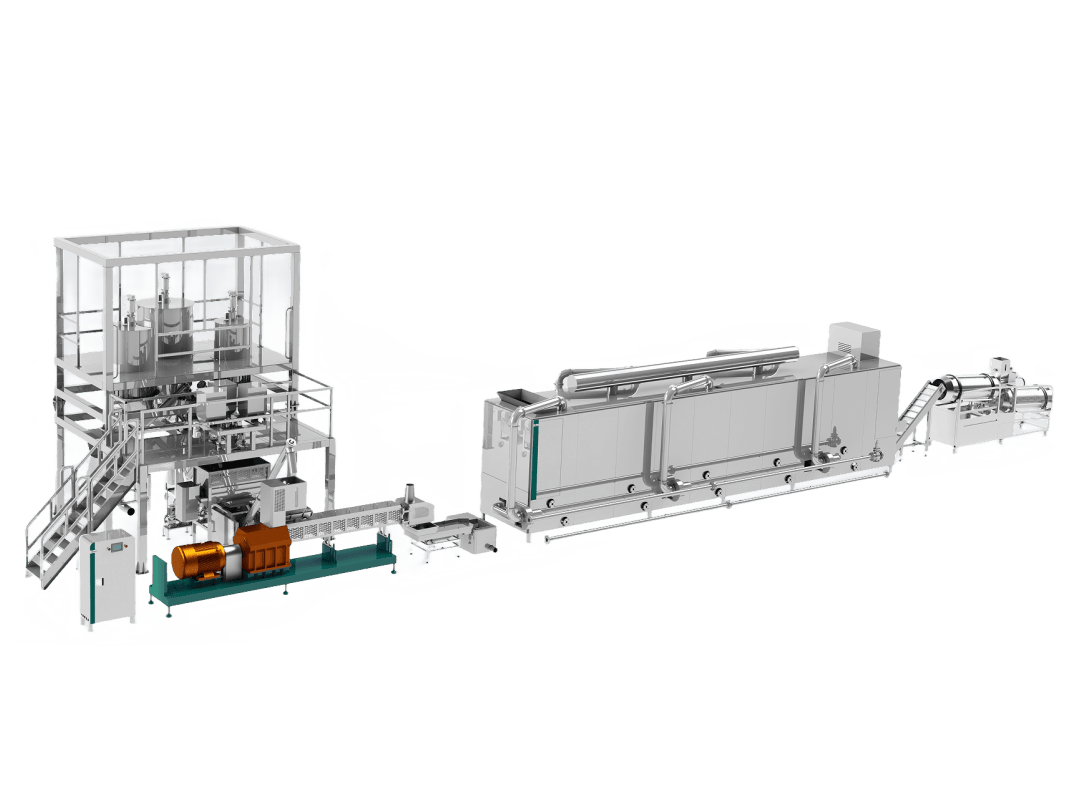
| Dry Kibble (Dog/Cat) | Mixer → Screw Conveyor → Twin-Screw Extruder → Dryer → Coater → Packaging | 100 kg/h – 5 t/h | Medium–High |
| Wet Canned Food | Grinder → Mixer → Can Filler → Retort Sterilizer → Labeler | 500 – 10,000 cans/day | High |
| Freeze-Dried Food | Freezer → Vacuum Freeze Dryer → Packaging | 50 – 500 kg/batch | High |
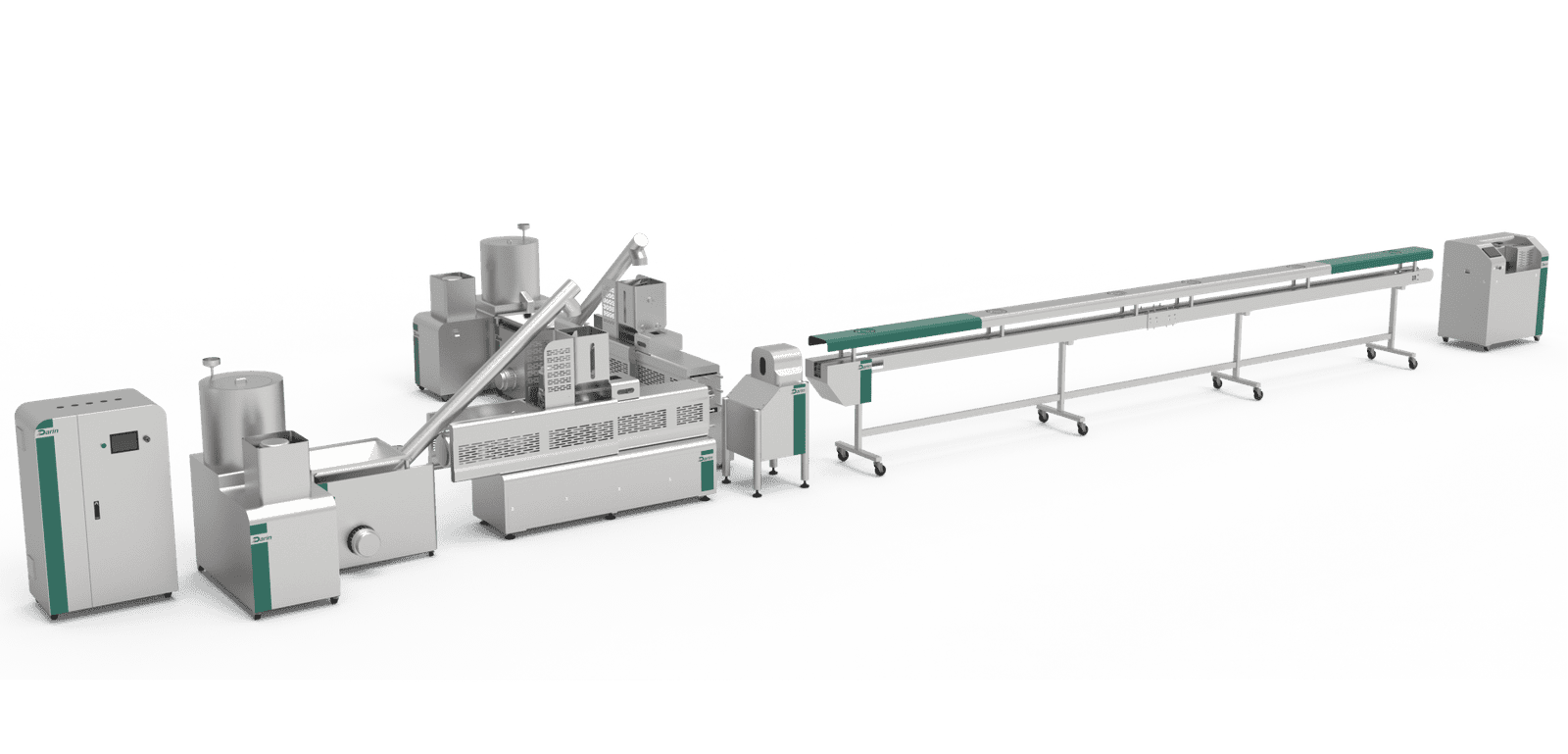
| Pet Treats (Snacks) | Mixer → Extruder/Moulder → Dryer → Coating Drum → Cutter → Packaging | 50 – 1000 pcs/min | Medium |
| Rawhide Chews/Kabob | Soaking Tank → Rolling Machine → Cutting/Pressing → Drying → Packaging | 1–2 t/day | Medium |
| Fish Feed | Mixer → Twin-Screw Extruder → Floating/Sinking Pellet Dryer → Coater → Packaging | 100 kg/h – 10 t/h | Medium–High |
3.3 Core Machinery for Dry Pet Food Production
The most common pet food category is dry kibble. Its production requires a continuous extrusion line:
- Mixer: Prepares raw materials with uniform moisture distribution.
- Screw Conveyor: Transports blended mix into the extruder.
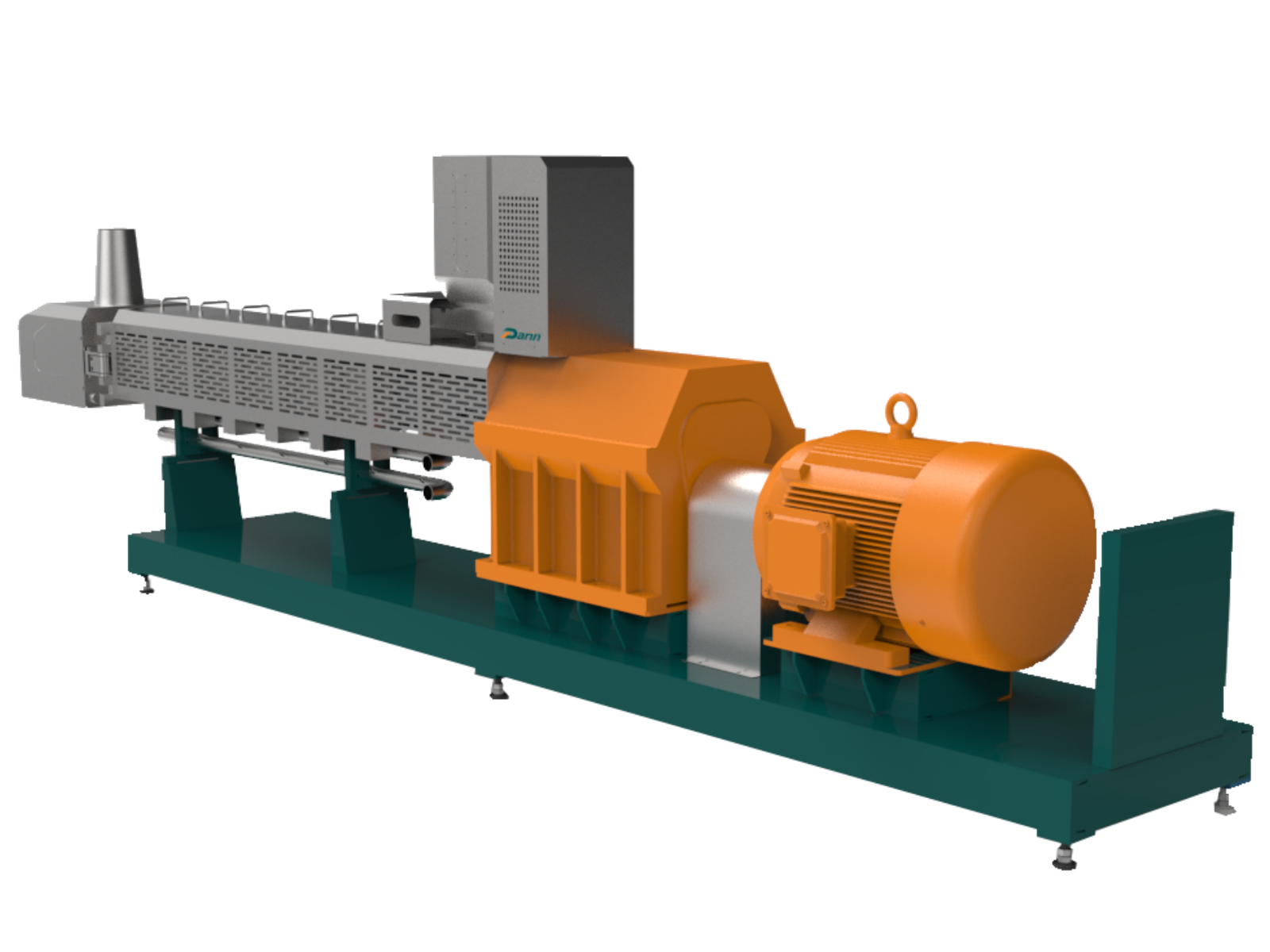
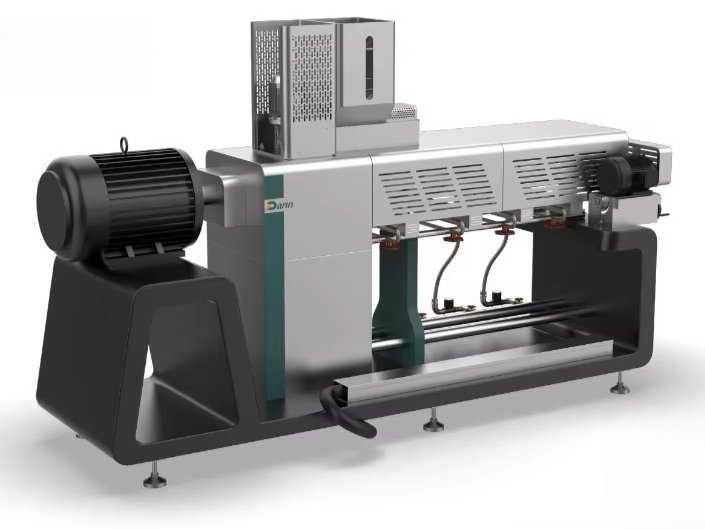
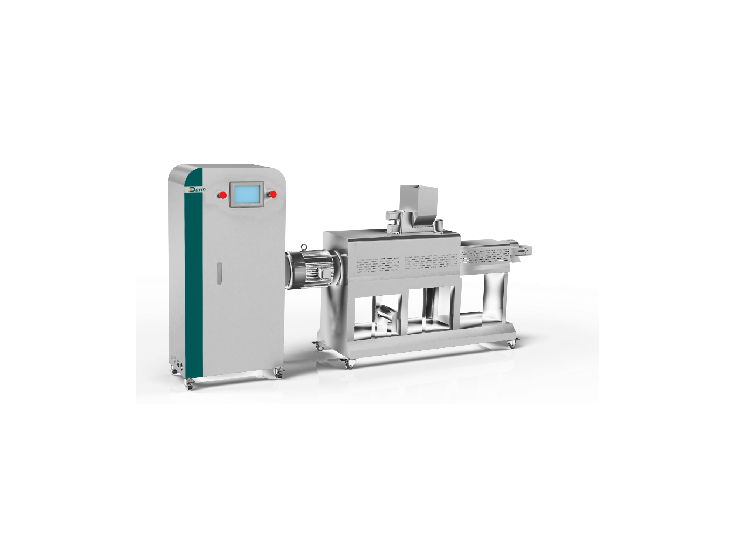
- Twin-Screw Extruder: Heart of the line, controls cooking, expansion, and shaping.
- Dryer (Multi-layer or Belt): Reduces moisture to 8–12% for shelf stability.
- Flavoring/Coating Drum: Applies palatants, fats, or functional additives.
- Cooling System: Prevents condensation before packaging.
- Automatic Packaging Machine: Seals, labels, and bags the finished kibble.
Chart 1 – Process Flow for Dry Pet Food
Raw Material → Mixing → Extrusion → Drying → Coating → Cooling → Packaging
3.4 Technical Specifications of Key Equipment
Twin-Screw Extruder (Example: Darin DR-65/70/85/95 Series):
- Capacity: 100 kg/h – 5,000 kg/h.
- Barrel Heating Zones: 8–12.
- Screw Material: Nitrided steel or alloy (wear-resistant).
- Drive System: Frequency-controlled motor for variable speed.
- PLC Control: Siemens/Delta automation with recipe storage.
- Features: Self-cleaning, flexible die change, energy-efficient.
Dryer:
- Type: Gas/electric/steam belt dryers.
- Moisture Control: 8–12% final product moisture.
- Automation: Temperature & airflow controlled by PLC.
- Capacity: Matches extruder output.
Coating System:
- Function: Evenly sprays palatant/oil on cooled kibble.
- Control: Automatic dosing pumps.
3.5 Capacity Planning and Investment Ranges
Table 2 – Investment by Production Scale (Dry Pet Food Line)
| Scale | Capacity (kg/h) | Machinery Cost (USD) | Total Setup Cost (USD, incl. utilities) | Suitable For |
|---|---|---|---|---|
| Small Startup | 100–200 | $80,000 – $150,000 | $150,000 – $250,000 | Local niche brands |
| Medium Factory | 500–1,000 | $200,000 – $400,000 | $400,000 – $700,000 | Regional brands |
| Industrial | 2,000–5,000 | $800,000 – $2,000,000 | $1.5M – $3M+ | Export/Global players |
3.6 Automation and Control Systems
Modern machinery offers:
- PLC with HMI touchscreens for recipe management.
- SCADA integration for centralized monitoring.
- IoT sensors for predictive maintenance.
- Automated cleaning systems (CIP) for hygiene compliance.
Automation reduces labor dependency and minimizes contamination risks.
3.7 Compliance and Certifications for Machinery
Machinery must comply with food-grade standards:
- Materials: Contact parts made of SS304/SS316.
- Certifications: CE (EU), UL (USA), ISO 9001, GMP.
- Safety: Emergency stops, dust collection, explosion-proof for dryers.
- Energy Efficiency: Steam recovery systems, insulation.
3.8 Case Studies – Machinery Success
- Latin America: A startup in Mexico invested in a 500 kg/h twin-screw line. Within 3 years, they scaled to 2 t/h by adding additional dryers and packaging units.
- Europe: A premium cat food brand in Italy started with a freeze-drying line (200 kg/day). By focusing on export markets, they recouped investment in under 2 years.
- China: A local player entered the market with a 1 t/h extruder line, selling affordable dog kibble. By keeping CAPEX low and focusing on volume, they gained 8% market share regionally.
3.9 Practical Tips for Machinery Selection
- Define product focus: Don’t buy a wet food line if your strategy is dry kibble.
- Plan for scalability: Choose modular designs that allow upgrades.
- Consider local utility costs: Gas vs. electric dryers depending on your region.
- Verify supplier reputation: Ask for reference installations.
- Check after-sales support: Spare parts, installation, training.
- Negotiate turnkey solutions: Cover machinery, installation, and operator training in one package.
The right machinery is the engine of your pet food business. From small-scale extruders to full industrial lines, your choice should align with your market positioning, financial capacity, and growth ambitions. Darin Machinery, as one of the leading manufacturers, offers customized extrusion and pet treat lines tailored to your startup or industrial-scale needs.
Step 4: Pet Food Formulation Development
Once you have chosen your production line, the next critical step is developing nutritionally balanced and palatable pet food formulations. A well-designed formula not only ensures compliance with AAFCO/FEDIAF standards but also builds consumer trust and repeat purchases. Poor formulation, on the other hand, can lead to recalls, pet health problems, and brand failure. In this section, we will explore how to design, test, and optimize recipes for dogs, cats, and fish feed.
4.1 Why Pet Food Formulation Matters
- Nutritional adequacy: Ensures pets meet daily dietary needs.
- Palatability: Flavor, texture, and aroma drive acceptance.
- Digestibility: High-quality proteins and balanced fibers improve absorption.
- Market differentiation: Grain-free, hypoallergenic, functional diets stand out.
- Compliance: Must meet AAFCO (US) or FEDIAF (EU) nutrient profiles.
Pet food formulations can be developed without veterinary or nutritional expertise.False
Professional formulation requires veterinary nutritionists to ensure safety, regulatory compliance, and long-term pet health.
4.2 Key Nutritional Requirements
Pet food formulations differ by species and life stage.
Table 1 – Minimum Nutritional Requirements (AAFCO Guidelines)
| Nutrient | Dogs (Adult) | Cats (Adult) | Fish Feed (Tilapia) |
|---|---|---|---|
| Protein (%) | ≥18 | ≥26 | 28–35 |
| Fat (%) | ≥5 | ≥9 | 6–10 |
| Fiber (%) | ≤5 | ≤5 | ≤4 |
| Moisture (%) | ≤10 (dry) | ≤10 (dry) | ≤10 |
| Taurine (%) | Not required | ≥0.1 | Not required |
| Omega-3 (EPA/DHA) | Recommended | Recommended | Required for growth |
Key Notes:
- Cats are obligate carnivores: require higher protein and taurine.
- Dogs are omnivores: tolerate grains and vegetables.
- Fish require precise amino acid balance for growth and survival.
4.3 Ingredient Categories
-
Protein Sources
- Animal: Chicken, beef, fish meal, lamb, duck.
- Plant: Soy protein concentrate, pea protein, potato protein.
-
Carbohydrates
- Corn, rice, barley, oats, sweet potatoes, peas.
-
Fats & Oils
- Poultry fat, fish oil, flaxseed oil, tallow.
-
Functional Additives
- Omega-3 fatty acids for skin/coat.
- Probiotics for gut health.
- Glucosamine & chondroitin for joint support.
-
Vitamins & Minerals
- Vitamin A, D, E, B-complex.
- Calcium, phosphorus, zinc, selenium.
4.4 Sample Formulas
a) Dog Food (Adult Maintenance, Dry Kibble)
- Chicken meal: 25%
- Corn meal: 20%
- Rice: 15%
- Poultry fat: 8%
- Beet pulp (fiber): 4%
- Fish meal: 5%
- Vitamins & minerals: 2%
- Flavor enhancer/palatant: 1%
Guaranteed Analysis: Protein 24%, Fat 12%, Fiber 4%, Moisture 10%
b) Cat Food (Adult Maintenance, Dry)
- Fish meal: 30%
- Chicken meal: 20%
- Rice: 15%
- Animal fat: 10%
- Taurine supplement: 0.1%
- Yeast extract (palatant): 2%
- Vitamins & minerals: 2%
- Others (fillers & binding agents): balance
Guaranteed Analysis: Protein 32%, Fat 14%, Taurine 0.1%
c) Fish Feed (Floating Tilapia Pellets)
- Soybean meal: 25%
- Fish meal: 15%
- Corn gluten meal: 10%
- Wheat flour (binder): 20%
- Fish oil: 5%
- Vitamin-mineral premix: 2%
- Others (starch, additives): balance
Guaranteed Analysis: Protein 30%, Fat 8%, Fiber 4%
4.5 Testing and Optimization
- Lab testing: Verify nutrient profile matches claims.
- Palatability tests: Offer to test groups of dogs/cats; measure acceptance rates.
- Digestibility trials: Analyze fecal output and nutrient absorption.
- Shelf-life studies: Ensure no rancidity or microbial growth.
Table 2 – Quality Control Tests in Formulation Development
| Test Type | Method | Standard/Target Value |
|---|---|---|
| Crude Protein | Kjeldahl method | ±2% of label claim |
| Crude Fat | Soxhlet extraction | ±1% of label claim |
| Moisture | Oven drying | ≤10% |
| Salmonella | Microbiology | Absent/25 g |
| Shelf-life | Oxidation index | ≤PV 5 meq/kg fat |
4.6 Special Diets & Functional Foods
Trends in the pet food industry include:
- Grain-free diets: Using peas, lentils, or sweet potatoes instead of corn/wheat.
- Limited ingredient diets (LID): For pets with allergies.
- Veterinary diets: Kidney support, weight control, hypoallergenic.
- Functional treats: Dental chews, skin & coat snacks, joint health biscuits.
- Sustainable proteins: Insect meal, algae protein, lab-grown meat.
4.7 Case Studies
- Premium Grain-Free Brand (USA): Launched a pea- and lentil-based kibble for dogs allergic to wheat. Within 2 years, revenue surpassed $10M.
- Freeze-Dried Raw Snacks (China): A small brand used chicken liver and fish as base. By focusing on cats, they built a niche premium brand.
- Functional Dental Treats (Europe): Startup added enzymes to reduce plaque and marketed through vet clinics. Achieved rapid adoption.
4.8 Practical Tips
- Work with veterinary nutritionists when formulating.
- Always run pilot-scale extrusion tests before mass production.
- Maintain ingredient traceability (lot numbers, supplier certifications).
- Adjust formulations seasonally (different fat stability in hot climates).
- Keep R&D ongoing — consumer preferences change quickly.
Formulation development is the science and art of pet food production. It requires balancing nutritional adequacy, palatability, compliance, and cost-effectiveness. By using the right proteins, carbohydrates, fats, and functional additives, and by testing through lab and feeding trials, you can build a brand that stands out in an increasingly competitive industry.
Step 5: Facility Setup & Quality Control for Pet Food Production
Setting up your facility is the foundation of safe, efficient, and scalable pet food manufacturing. Even if you have the best machinery and recipes, poor layout, insufficient utilities, or weak quality control can lead to contamination, production inefficiencies, or regulatory failures. This step covers how to design a compliant pet food facility, integrate utilities, and build a strong quality control system to maintain product safety and consistency.
5.1 Facility Layout Design
The layout of a pet food factory must follow food-grade production standards, ensuring hygiene, safety, and efficiency. The facility should support a linear flow — from raw material entry to finished product exit — without cross-contamination.
Basic Layout Sequence:
Raw Material Storage → Pre-processing (grinding, mixing) → Extrusion/Cooking → Drying → Coating → Cooling → Packaging → Finished Goods Storage
Key Principles:
- Segregation: Separate raw and finished goods to prevent cross-contamination.
- Zoning: Distinguish “clean” and “unclean” areas (e.g., raw meat vs packaging).
- Ventilation: Install air filtration systems to control dust and odors.
- Hygienic design: Rounded corners, easy-to-clean walls/floors, stainless steel drains.
- Staff flow: Dedicated locker rooms, changing areas, and handwashing stations.
Table 1 – Recommended Area Allocation for a 1 t/h Dry Pet Food Plant (Example)
| Section | Area (m²) | Notes |
|---|---|---|
| Raw Material Storage | 200 | Temperature-controlled for grains/meat |
| Mixing & Extrusion Zone | 300 | Stainless steel equipment, dust control |
| Drying & Cooling | 250 | Proper ventilation, fire protection |
| Coating & Packaging | 200 | Separated from raw material zone |
| Finished Goods Warehouse | 150 | FIFO system, pest control measures |
| QC Laboratory | 80 | Equipped for chemical & microbial tests |
| Staff Facilities (offices, lockers) | 120 | Hygiene-critical entry zones |
5.2 Utility Requirements
Pet food production is energy- and utility-intensive. Proper planning prevents production bottlenecks.
- Electricity: Extruders, conveyors, packaging machines. (50–200 kW for mid-sized lines).
- Steam/Hot Water: For cooking, extrusion, and drying. A boiler system is often required.
- Compressed Air: For pneumatic controls and packaging machines.
- Cooling Water/Chillers: For extruder barrels, dryers, and post-processing.
- Ventilation/Dust Collection: Essential in mixing and extrusion zones.
- Wastewater Treatment: For cleaning operations. Must meet environmental regulations.
Table 2 – Utility Estimates for 1 t/h Dry Pet Food Line
| Utility Type | Requirement | Notes |
|---|---|---|
| Electricity | 150–200 kW | Depends on extruder size |
| Steam | 800–1000 kg/h | For extrusion and drying |
| Compressed Air | 0.8–1.0 m³/min @ 0.8 MPa | Pneumatic controls |
| Cooling Water | 10–15 m³/h | Closed-loop system preferred |
| Ventilation | 10–15 air changes/hour | Dust filters & exhaust fans |
5.3 Quality Control (QC) Laboratory Setup
A dedicated QC lab ensures regulatory compliance and product safety.
Minimum Equipment Required:
- Oven dryers – Moisture testing.
- Kjeldahl apparatus – Protein content analysis.
- Soxhlet extractor – Fat content determination.
- pH meters – Acid/base balance.
- Spectrophotometer – Vitamin/mineral analysis.
- Microbiology incubators – Pathogen detection (Salmonella, E. coli).
- Texture analyzer – Kibble hardness testing.
Critical Tests Conducted:
- Incoming Raw Materials: Check moisture, protein, mycotoxins.
- In-Process Control: Extrusion temperature, moisture, expansion ratio.
- Finished Product: Nutritional profile, microbiological safety, palatability tests.
- Packaging QC: Seal integrity, oxygen transmission rate (OTR).
Table 3 – QC Parameters for Dry Dog Food (Example)
| Parameter | Method | Acceptable Range | Frequency |
|---|---|---|---|
| Moisture (%) | Oven drying | 8–12% | Every batch |
| Protein (%) | Kjeldahl method | ≥24% | Weekly |
| Fat (%) | Soxhlet extraction | 8–15% | Weekly |
| Salmonella | Microbiology | Absent/25 g | Every batch |
| Aflatoxin B1 | ELISA | ≤20 ppb | Monthly |
| Shelf Life Test | Accelerated aging | ≥12 months | Per new formula |
5.4 Hygiene & Safety Protocols
- CIP (Clean-In-Place) Systems: Automated cleaning of extruder and dryers.
- Pest Control: Rodent-proof storage, scheduled fumigation.
- Hygiene Audits: Weekly inspections, swab testing of equipment.
- Fire Safety: Especially critical in dryers (explosion-proof designs).
- Employee Training: PPE use, hand hygiene, cross-contamination prevention.
5.5 Certifications & Compliance in Facility Setup
To legally operate and gain customer trust, facilities must be certified:
- HACCP: Hazard prevention framework.
- ISO 22000: Global food safety management.
- GMP: Ensures Good Manufacturing Practices.
- BRC/IFS Food Safety Standards: Required by many international retailers.
- Environmental Permits: Waste disposal, air emissions, water use.
5.6 Case Studies – Facility Success
- Europe (Germany): A cat food producer designed a linear facility flow. By implementing HACCP and ISO 22000, they secured contracts with Carrefour and Lidl.
- Asia (China): A startup invested in automated CIP cleaning. This reduced downtime by 20% and improved compliance audit results.
- USA (Texas): A dog kibble plant implemented a dust collection system that reduced worker respiratory issues and passed OSHA inspections smoothly.
5.7 Practical Tips for Facility Setup
- Plan ahead for expansion: Allocate space for future machinery.
- Use modular utilities: Makes scaling easier (e.g., modular boilers).
- Automate where possible: Reduces contamination and labor costs.
- Invest in your QC lab: Certification bodies require documented lab testing.
- Simulate audits before launch: Fix compliance gaps early.
A properly designed facility with robust quality control ensures that your pet food is safe, compliant, and consistent. From hygienic layouts and sufficient utilities to in-house QC labs and certifications, this stage builds the operational backbone of your business. Investing here protects your brand from recalls and builds credibility with both regulators and consumers.
Step 6: Packaging & Branding for Pet Food
Packaging and branding are not just the final steps of the pet food production process — they are powerful tools that directly influence shelf life, consumer trust, and market competitiveness. Even with a high-quality product, poor packaging or weak branding can prevent your pet food from standing out in crowded stores or e-commerce platforms. In this section, we’ll examine packaging technologies, labeling requirements, brand design strategies, and real-world examples of successful pet food brands.
6.1 The Role of Packaging in Pet Food
Packaging serves three critical functions:
- Protection – Maintains freshness and prevents spoilage.
- Compliance – Displays mandatory information (nutritional facts, feeding guidelines, lot number).
- Marketing – Influences consumer perception and buying decisions.
Packaging is mainly for visual appeal and has no role in product preservation.False
Packaging directly affects shelf life by controlling moisture, oxygen, and microbial exposure, ensuring product safety and freshness.
6.2 Packaging Materials and Formats
The right packaging extends shelf life and improves consumer convenience.
Table 1 – Common Packaging Formats for Pet Food
| Packaging Type | Application | Shelf Life Impact | Cost Level | Notes |
|---|---|---|---|---|
| Multi-layer laminated bags | Dry kibble, treats | High – oxygen & moisture barrier | Medium | Most common for dry food |
| Resealable plastic pouches | Treats, snacks | Medium – easy to use | Medium | Popular for small pack sizes |
| Paper bags with inner liner | Economy kibble | Low – less protective | Low | Low-cost option, less premium appeal |
| Metal cans/jars | Wet pet food | High – sterile, long shelf life | High | Requires retort sterilization process |
| Glass jars | Premium wet/treats | High – premium look | High | Eco-friendly, niche market appeal |
| Vacuum packs | Freeze-dried foods | High – prevents oxidation | Medium–High | Often combined with nitrogen flushing |
6.3 Shelf Life Considerations
Pet food is prone to oxidation and microbial growth if packaging is inadequate.
- Dry food (kibble): Shelf life ~12–18 months in laminated bags.
- Wet food (canned): Shelf life ~2–3 years if sterilized properly.
- Freeze-dried treats: Shelf life 18–24 months with vacuum/nitrogen flushing.
- Snacks & chews: Shelf life 6–12 months depending on preservatives.
Table 2 – Shelf Life by Packaging Type
| Product Type | Packaging Type | Shelf Life (Months) |
|---|---|---|
| Dry Dog Food | Laminated bag w/ nitrogen | 12–18 |
| Cat Wet Food | Retort can | 24–36 |
| Freeze-Dried Snack | Vacuum pouch | 18–24 |
| Rawhide Chews | Plastic pouch | 6–12 |
6.4 Labeling Compliance
Packaging must comply with regulatory labeling laws.
Mandatory Label Elements:
- Brand & Product Name: Must reflect actual content.
- Net Weight: Metric + imperial units.
- Guaranteed Analysis: Protein, fat, fiber, moisture.
- Ingredient List: In descending order of weight.
- Nutritional Adequacy Statement: AAFCO/FEDIAF reference.
- Feeding Guidelines: Daily portions by weight/age.
- Traceability Info: Lot number, production date, best-before.
- Manufacturer Details: Name, address, contact info.
Example – AAFCO-Compliant Dry Dog Food Label:
- Brand Name: “HealthyPaws Grain-Free Dog Food”
- Net Weight: 5 kg (11 lbs)
- Guaranteed Analysis: Crude Protein (min) 26%, Crude Fat (min) 12%, Crude Fiber (max) 4%, Moisture (max) 10%
- Ingredient List: Chicken meal, peas, sweet potatoes, chicken fat, flaxseed, vitamins, minerals.
- Feeding Guidelines: 1–2 cups/day for dogs up to 10 kg.
- Nutritional Adequacy: “Formulated to meet the nutritional levels established by the AAFCO Dog Food Nutrient Profiles for maintenance.”
6.5 Branding Strategy for Pet Food
Branding is the soul of your product. It creates emotional connections with pet owners.
Branding Essentials:
- Unique Selling Proposition (USP): Example: “Human-Grade Ingredients,” “Veterinarian Approved.”
- Visual Identity: Logo, brand colors, typography.
- Storytelling: Communicate values (sustainability, local sourcing, functional nutrition).
- Target Positioning: Budget-friendly, premium, organic, or specialized diets.
- Consistency Across Channels: Packaging, website, social media, retail displays.
Consumer Psychology in Branding:
- Bright colors & playful mascots → appeal to budget buyers.
- Clean minimal design → premium, organic positioning.
- Scientific/clinical imagery → veterinary diets.
6.6 Digital Packaging Innovations
- QR Codes: Link to batch traceability, certifications, or brand story.
- Augmented Reality (AR): Interactive packaging for premium products.
- Sustainable Packaging: Biodegradable films, recyclable paper.
- Smart Labels: Temperature/time indicators for sensitive products.
6.7 Case Studies – Packaging & Branding Success
- Blue Buffalo (USA): Positioned as “natural pet food.” Clean, earthy packaging + heavy storytelling = massive growth.
- Orijen (Canada): Premium branding with bold colors and high meat content claims. Packaging emphasizes ingredients.
- Inaba (Japan): Wet cat treats in pouches, branded with playful cats. Focused on convenience + flavor variety.
- China Premium Cat Snacks Startup: Used vacuum-packed freeze-dried salmon cubes with luxury-style packaging; gained popularity on JD.com.
6.8 Practical Tips for Packaging & Branding
- Start small: Use stock bags with custom stickers until sales justify custom-printed packs.
- Invest in resealable options: Convenience increases customer loyalty.
- Highlight 2–3 key claims on the front: Grain-free, high protein, vet-approved.
- Test with focus groups: Show prototypes to pet owners before mass production.
- Think about sustainability: More consumers prefer recyclable packaging.
Packaging and branding are the bridge between your factory and your customers. The right packaging protects freshness and ensures compliance, while branding creates trust and emotional appeal. Whether you’re selling premium cat snacks or budget dog kibble, investing in thoughtful packaging and strong brand positioning will set you apart in a competitive market.
Step 7: Distribution & Sales Channels for Pet Food
Even the best pet food formulation with excellent packaging will fail if customers cannot easily find and purchase it. Distribution and sales channels determine how your product reaches the market — whether through local pet shops, large supermarkets, online platforms, or international exports. In this step, I will provide a deep dive into the different distribution models, logistics considerations, and strategies for scaling sales from startup to global brand.
7.1 Why Distribution Strategy Is Critical
- Accessibility: Consumers buy what is most convenient to access.
- Market penetration: Different channels reach different demographics.
- Revenue growth: A balanced mix of offline and online sales maximizes coverage.
- Scalability: Partnerships with distributors and retailers accelerate expansion.
Pet food businesses can rely only on online sales and ignore offline distribution.False
While e-commerce is growing rapidly, offline sales through pet shops, veterinary clinics, and supermarkets still account for more than 70% of global pet food sales.
7.2 Offline Sales Channels
a) Pet Shops & Specialty Stores
- Advantages: Niche customer base, trusted by pet owners.
- Challenges: Limited volume, need for retailer relationships.
- Best for: Premium brands, treats, functional foods.
b) Veterinary Clinics
- Advantages: High credibility, vet endorsements drive premium sales.
- Challenges: Requires veterinary diet certifications and smaller product ranges.
- Best for: Prescription diets, functional treats, premium wet foods.
c) Supermarkets & Hypermarkets
- Advantages: High visibility, volume sales, impulse buys.
- Challenges: Price competition, slotting fees, high MOQ (minimum order quantity).
- Best for: Mass-market kibble and canned food.
d) Agricultural Supply Stores (Rural Markets)
- Advantages: Access to dog owners in non-urban areas.
- Challenges: Lower margins, bulk packaging required.
- Best for: Economy dog food, fish feed.
7.3 Online Sales Channels
a) E-commerce Platforms
- Amazon, Chewy (USA), JD.com, Tmall (China), Zooplus (EU).
- Advantages: Fast market entry, wide reach.
- Challenges: Platform fees, high competition, logistics handling.
b) Direct-to-Consumer (D2C) Websites
- Advantages: Higher margins, full control over branding and customer data.
- Challenges: Requires investment in digital marketing and fulfillment.
- Best for: Subscription boxes, niche premium brands.
c) Social Commerce
- Platforms like Instagram, TikTok, WeChat, and Facebook Shops allow direct selling.
- Works well with pet influencers who promote new products.
7.4 Export and International Distribution
Exporting pet food offers access to fast-growing markets but requires careful planning.
Steps for Export:
- Obtain required certifications (ISO, HACCP, veterinary health certificate).
- Adapt labeling to local language and regulations.
- Partner with local distributors or importers.
- Plan logistics: containerized shipping, cold chain for wet/frozen foods.
- Negotiate MOQs and payment terms with overseas buyers.
Table 1 – Export Market Opportunities
| Region | Growth Rate | Product Demand | Entry Challenges |
|---|---|---|---|
| Asia-Pacific | 8% CAGR | Premium cat/dog food | Regulatory complexity, language barrier |
| Latin America | 6% CAGR | Affordable dry food | Import tariffs, logistics costs |
| Middle East | 7% CAGR | Premium wet/treats | Labeling in Arabic, halal certification |
| Africa | 7.5% CAGR | Bulk economy dog food | Distribution networks still developing |
7.5 Logistics & Warehousing Considerations
-
Storage Conditions:
- Dry food → cool, dry warehouses.
- Wet/canned food → ambient storage (sterilized).
- Freeze-dried → moisture-controlled environment.
-
Inventory Management:
- FIFO (First In, First Out) system.
- Batch/lot tracking for recalls.
-
Distribution Models:
- Direct Distribution: Factory → Retailers.
- Wholesale Distribution: Factory → Distributor → Retailers.
- Hybrid: Mix of both for flexibility.
Table 2 – Cost Comparison of Distribution Models
| Model | Cost Efficiency | Market Reach | Control Level | Best For |
|---|---|---|---|---|
| Direct Distribution | Medium | Limited | High | Local startups |
| Wholesale | High | Wide | Medium | National brands |
| Hybrid | Balanced | Flexible | Medium-High | Scaling companies |
7.6 Case Studies
- USA (Subscription Startup): A small brand launched a D2C model with customized monthly dog food boxes. Within 2 years, they expanded to Amazon and Chewy for wider reach.
- China (Premium Cat Treats): A freeze-dried snack company partnered with Tmall distributors. Heavy use of livestream e-commerce drove sales.
- Brazil (Mass-Market Dog Food): Focused on supermarkets with bulk packs. Strong local distributor partnerships allowed penetration into 1,000+ stores.
7.7 Practical Tips for Distribution
- Start local: Build brand presence in pet shops before scaling.
- Use distributors for expansion: They have networks and regulatory experience.
- Balance online & offline: Don’t rely on only one channel.
- Offer sampling programs: Place trial packs in vet clinics and online orders.
- Leverage logistics partners: Third-party fulfillment centers can manage warehousing and last-mile delivery.
Distribution and sales channels are the lifeline of your pet food business. By carefully choosing a mix of offline (pet shops, supermarkets, vets) and online (e-commerce, D2C, social media) strategies, you can reach diverse consumer groups and scale effectively. Export markets further expand opportunities, provided you meet regulatory and logistical requirements.
Step 8: Marketing & Growth Strategy for a Pet Food Business
Even with high-quality formulations, safe facilities, and solid distribution channels, your pet food business will not thrive without strategic marketing. The global pet food market is crowded with established giants (Mars, Nestlé Purina, Royal Canin), so new entrants must leverage branding, storytelling, and digital tools to carve a niche. In this step, we will cover branding strategy, digital and offline marketing, influencer partnerships, growth hacks, and ROI optimization — all crucial to scaling your pet food business.
8.1 Why Marketing Strategy Is Essential
- Builds Trust: Pet owners are cautious; they buy from brands they trust.
- Differentiates Products: Marketing highlights your USP (grain-free, organic, functional).
- Drives Sales: Without awareness, even the best product sits in warehouses.
- Sustains Growth: Marketing nurtures repeat purchases and customer loyalty.
Pet food businesses can succeed based solely on product quality, without marketing investment.False
While quality is crucial, marketing ensures visibility, builds trust, and generates consistent sales in competitive markets.
8.2 Defining Your Brand Positioning
Before launching campaigns, decide where your brand stands in the market:
- Budget-friendly: Affordable, bulk packs.
- Premium: High protein, human-grade ingredients, sustainable.
- Functional: Veterinary diets, senior pet support, hypoallergenic.
- Specialized: Freeze-dried snacks, insect protein, organic.
Example Brand Positioning Matrix
| Segment | Target Consumer | Example Brands | USP Focus |
|---|---|---|---|
| Budget | Rural families, large dogs | Pedigree | Affordable, available everywhere |
| Premium | Urban professionals | Orijen, Blue Buffalo | Grain-free, high protein |
| Functional | Vet-recommended owners | Hill’s Science Diet | Clinical nutrition, prescription |
| Specialized | Niche pet parents | Stella & Chewy’s | Freeze-dried, raw, organic |
8.3 Digital Marketing Channels
a) Website & SEO
- Build a D2C website with e-commerce capability.
- Optimize for Google SEO with keywords: “grain-free dog food,” “premium cat treats,” “fish feed supplier.”
- Create educational blogs: “How to choose the best food for your senior dog.”
b) Social Media
- Instagram & TikTok: Pet photos, feeding demos, behind-the-scenes factory videos.
- Facebook: Community building, ads for specific demographics.
- YouTube: Educational content, vet interviews, “pet food myth-busting.”
c) Paid Ads
- Google Ads: Target high-intent searches (“buy cat food online”).
- Social Ads: Lookalike audiences for pet owners.
- Amazon Ads: Sponsored listings for faster product discovery.
d) Email Marketing
- Send feeding tips, product launches, and promotions.
- Build loyalty through subscription offers.
8.4 Offline Marketing Strategies
- Sampling Programs: Offer free packs in vet clinics, pet shops, grooming salons.
- Pet Shows & Expos: Showcase your products at events (Interzoo, Global Pet Expo).
- Vet Endorsements: Collaborate with veterinarians to recommend your food.
- Retail Promotions: Buy-one-get-one offers, bundle discounts.
8.5 Influencer & Community Marketing
Pet owners trust other pet owners. Leveraging influencers and communities accelerates growth.
- Micro-influencers (1k–10k followers): High engagement, affordable partnerships.
- Pet bloggers & YouTubers: Trusted voices for reviews and unboxings.
- Community sponsorships: Support local shelters, adoption events.
Case Example – Freeze-Dried Cat Treats in China: A startup partnered with TikTok cat influencers, creating viral feeding videos. Sales surged by 400% in three months.
8.6 Growth Hacks for Pet Food Startups
- Subscription Model: Offer auto-ship discounts. Encourages recurring revenue.
- Loyalty Programs: Reward points for repeat buyers.
- Co-Branding: Partner with vets, shelters, or pet accessory brands.
- User-Generated Content (UGC): Encourage customers to post feeding videos with branded hashtags.
- Localized Marketing: Adapt campaigns by region — grain-free focus in the USA, freeze-dried in Asia, functional diets in Europe.
8.7 ROI and Marketing Budgets
Effective marketing requires budgeting and ROI tracking.
Table 1 – Typical Marketing Budget Allocation for Startups
| Channel | Budget % | Expected ROI |
|---|---|---|
| Digital Ads | 35% | 3–5x |
| Influencers | 20% | 4–6x |
| Sampling/Offline | 20% | 2–3x |
| Content/SEO | 15% | 5–7x (long-term) |
| Events/Expos | 10% | 2–4x |
KPI Tracking Metrics:
- Customer Acquisition Cost (CAC).
- Return on Ad Spend (ROAS).
- Subscription renewal rate.
- Average order value (AOV).
8.8 Case Studies – Marketing Success
- Blue Buffalo (USA): Focused on “natural” branding, used storytelling and vet endorsements. Acquired by General Mills for $8 billion.
- Orijen (Canada): Emphasized “biologically appropriate” nutrition. Strong visual branding with bold colors. Expanded globally via online retail.
- Startup in Brazil: Launched a budget kibble brand. Used radio and supermarket promotions for rural markets, achieving fast adoption.
- China Freeze-Dried Brand: Leveraged livestreaming and TikTok influencers. Built a premium cat brand in under 3 years.
8.9 Practical Tips for Marketing Execution
- Start with one USP: Don’t overwhelm consumers; lead with your strongest claim.
- Invest in packaging photography: High-quality visuals increase online sales.
- Use storytelling: Share the journey of your brand, factory, or pets.
- Measure everything: Track CAC, ROAS, and LTV to adjust campaigns.
- Reinvest early profits into marketing: Scaling requires visibility.
Marketing is the engine of growth for your pet food business. By defining a clear brand position, leveraging digital and offline campaigns, working with influencers, and tracking ROI, you can compete effectively against global giants. Remember: pet food is an emotional purchase — marketing should build trust and connect with pet parents’ love for their animals.
Step 9: Financial Planning & ROI Forecast for a Pet Food Business
Even the most innovative pet food brands can fail if their financial planning is weak. Accurate financial modeling ensures you understand startup costs, operating expenses, expected margins, and payback periods before committing to large-scale investments. In this section, we will analyze CAPEX (capital expenditure), OPEX (operating expenditure), pricing strategies, and ROI scenarios to help you build a realistic financial roadmap for your pet food business.
9.1 Importance of Financial Planning
- Avoids undercapitalization: Many startups fail due to insufficient cash flow.
- Ensures investor confidence: Clear ROI models attract funding.
- Guides decision-making: Whether to start small or launch industrial scale.
- Supports scalability: Financial planning prepares for expansions.
Pet food startups usually require little financial planning, as profits come quickly.False
Pet food businesses are capital- and regulation-intensive, with ROI typically taking 2–4 years depending on scale and distribution.
9.2 Capital Expenditure (CAPEX) – Startup Costs
CAPEX includes machinery, facility setup, and regulatory approvals.
Table 1 – CAPEX Estimates by Factory Scale (Dry Pet Food Example)
| Scale | Capacity (kg/h) | Machinery Cost (USD) | Facility + Utilities (USD) | Total CAPEX (USD) |
|---|---|---|---|---|
| Small Startup | 100–200 | $80,000 – $150,000 | $70,000 – $100,000 | $150,000 – $250,000 |
| Medium Factory | 500–1,000 | $200,000 – $400,000 | $200,000 – $300,000 | $400,000 – $700,000 |
| Industrial | 2,000–5,000 | $800,000 – $2M+ | $700,000 – $1.5M | $1.5M – $3M+ |
9.3 Operating Expenditure (OPEX) – Monthly Costs
OPEX includes raw materials, labor, utilities, packaging, logistics, and marketing.
Table 2 – Typical OPEX Breakdown (% of total costs)
| Expense Category | % of OPEX | Notes |
|---|---|---|
| Raw Materials | 40–50% | Protein, grains, additives |
| Labor | 10–15% | Operators, QC staff, admin |
| Utilities | 8–12% | Electricity, steam, water, air |
| Packaging | 8–10% | Laminated bags, cans, labels |
| Marketing & Sales | 10–20% | Ads, promotions, sampling |
| Logistics | 5–10% | Warehousing, distribution |
Example (Medium Factory, 1 t/h line):
- Monthly OPEX: ~$40,000 – $60,000
- Raw materials alone: ~$20,000 – $30,000
9.4 Pricing Strategy
Pricing must balance cost recovery, market positioning, and consumer willingness to pay.
- Budget segment: $0.80 – $1.20/kg (mass-market dog food).
- Mid-range: $2 – $3/kg (grain-free kibble, cat food).
- Premium: $5 – $8/kg (freeze-dried, human-grade).
Key Formula – Profit Margin (%)
[
\text{Profit Margin} = \frac{\text{Selling Price – Production Cost}}{\text{Selling Price}} \times 100
]
Example: If cost = $1.50/kg, selling price = $3/kg → Margin = 50%.
9.5 Break-Even Analysis
Break-even depends on CAPEX, OPEX, and sales volume.
Table 3 – Break-Even Scenarios
| Scale | Monthly Sales Volume (tons) | Revenue (USD) | OPEX (USD) | Net Profit (USD) | Payback Period |
|---|---|---|---|---|---|
| Small (200 kg/h) | 50 | $75,000 | $50,000 | $25,000 | 2–3 years |
| Medium (1 t/h) | 200 | $400,000 | $250,000 | $150,000 | 2–4 years |
| Industrial (5 t/h) | 1,000 | $2M+ | $1.3M | $700,000+ | 3–5 years |
Insights:
- Smaller factories recover investment faster but have limited scalability.
- Medium factories offer balanced ROI.
- Industrial plants require longer payback but dominate market share once scaled.
9.6 ROI Forecast
ROI (Return on Investment) is a key metric for evaluating success.
Formula:
[
ROI = \frac{\text{Net Profit}}{\text{Total Investment}} \times 100
]
Example (Medium Factory):
- Total CAPEX = $600,000
- Annual Net Profit = $1.2M – $1.5M (after OPEX)
- ROI = 200% – 250% within 3 years
9.7 Case Studies – Financial Models
- Brazil (Budget Dog Food): Invested $200,000 in a 200 kg/h line. Reached break-even in 2 years by selling economy kibble in supermarkets.
- Germany (Premium Cat Food): Invested $2M in freeze-drying technology. Despite high CAPEX, achieved 400% ROI in 5 years due to premium exports.
- China (Online Startup): Started with $300,000 medium-scale line. Focused on JD.com sales with freeze-dried cat snacks. ROI achieved in under 3 years.
9.8 Practical Tips for Financial Success
- Start lean: Begin with a smaller line to test the market, scale later.
- Secure raw material contracts: Lock prices to reduce volatility.
- Use financial software: Track OPEX, revenue, and inventory.
- Allocate 15–20% of revenue to marketing in early years.
- Diversify product lines: Treats, snacks, and supplements offer higher margins.
Financial planning is the compass of your pet food business. By calculating CAPEX, OPEX, profit margins, and ROI, you ensure sustainable growth and investor confidence. Break-even typically occurs in 2–4 years for well-managed operations, with higher ROI potential for premium and export-driven brands.
Step 10: Scaling & Future Trends in the Pet Food Business
Reaching profitability is only the beginning. To stay competitive in the global pet food industry, businesses must scale efficiently and adapt to emerging trends. Scaling involves not just expanding production capacity but also diversifying product lines, upgrading technology, and anticipating consumer demands. This step explores strategies for scaling your pet food business and the key industry trends shaping the future.
10.1 Strategies for Scaling Production
-
Modular Expansion of Production Lines
- Start with a 200–500 kg/h line and add extra extruders, dryers, or packaging machines as demand grows.
- Modular setups lower initial CAPEX and spread risk.
-
Automation Upgrades
- Add robotic packaging systems, automated palletizers, and smart QC sensors.
- Reduce labor dependency, improve consistency, and cut costs.
-
Vertical Integration
- Secure raw material supply (grain farms, fish meal suppliers).
- Invest in in-house packaging or logistics centers to reduce third-party costs.
-
Geographic Expansion
- After local market dominance, expand regionally or internationally.
- Adapt formulations (e.g., halal-certified for Middle East, fish-based for Asia).
-
Product Diversification
- Add complementary products: treats, supplements, functional snacks.
- Create a portfolio strategy — economy, mid-range, premium tiers.
10.2 Future Industry Trends
a) Premiumization
- Human-grade food: Consumers demand meat quality equal to human food.
- Functional diets: Weight management, skin/coat health, senior support.
- Customization: Breed-specific or DNA-based personalized nutrition.
b) Sustainability
- Alternative proteins: Insect meal, algae, plant-based proteins.
- Eco-packaging: Compostable pouches, recyclable laminates.
- Carbon-neutral operations: Energy-efficient factories, solar power integration.
c) Digital Transformation
- E-commerce dominance: Direct-to-consumer sales expected to surpass offline in some regions by 2030.
- AI-driven demand forecasting: Predict sales trends to optimize production.
- Smart pet tech integration: Nutrition apps connected to smart feeders.
d) Health & Safety Advances
- Stricter regulations: Global convergence of standards (ISO 22000 + FEDIAF + FDA).
- Transparency demands: QR codes linking to sourcing and nutritional data.
- Probiotics & nutraceuticals: Growing as add-ons in both kibble and treats.
10.3 Case Studies – Scaling Successfully
- USA Subscription Brand: Began with 100 kg/h small line; after 3 years, scaled to 1 t/h by reinvesting profits. Built a loyal base with auto-ship subscriptions.
- China Freeze-Dried Startup: Started niche; after securing funding, expanded to regional dominance with 5x production increase. Trend-driven success via Tmall.
- European Premium Exporter: Focused on human-grade wet food. Expanded to Asia and Middle East by adapting halal-certified recipes and recyclable packaging.
10.4 Practical Tips for Scaling
- Reinvest profits into automation instead of relying only on labor expansion.
- Monitor KPIs: Cost per kg produced, OEE (Overall Equipment Effectiveness), ROAS for marketing.
- Anticipate consumer shifts: Test small product runs before full-scale production.
- Stay certification-ready: Every scaling phase requires fresh audits.
- Build brand loyalty: Retention is cheaper than acquiring new customers.
Scaling a pet food business is about strategic investment in capacity, automation, and innovation, while staying ahead of consumer demands. The future belongs to brands that embrace premiumization, sustainability, digital transformation, and transparency. Those who adapt early will secure long-term market leadership.
Final Thoughts
Starting and scaling a pet food business is a journey of 10 key steps: from market research, regulatory compliance, and machinery selection, through formulation, facility setup, packaging, distribution, marketing, financial planning, and scaling with future trends. Each stage requires technical knowledge, investment, and strategic foresight.
Let’s Talk About Your Pet Food Project
If you’re planning to start or scale a pet food business, Darin Machinery can provide customized extrusion lines, freeze-drying systems, treat production equipment, and full turnkey solutions. With decades of expertise, we support clients from concept and formulation to installation and after-sales service.
📞 Contact us today at WhatsApp +86-156-5000-7983
🌐 Visit us at petreatsmachine.com
I’d be happy to walk you through a personalized roadmap for your project — step by step, from startup to success.