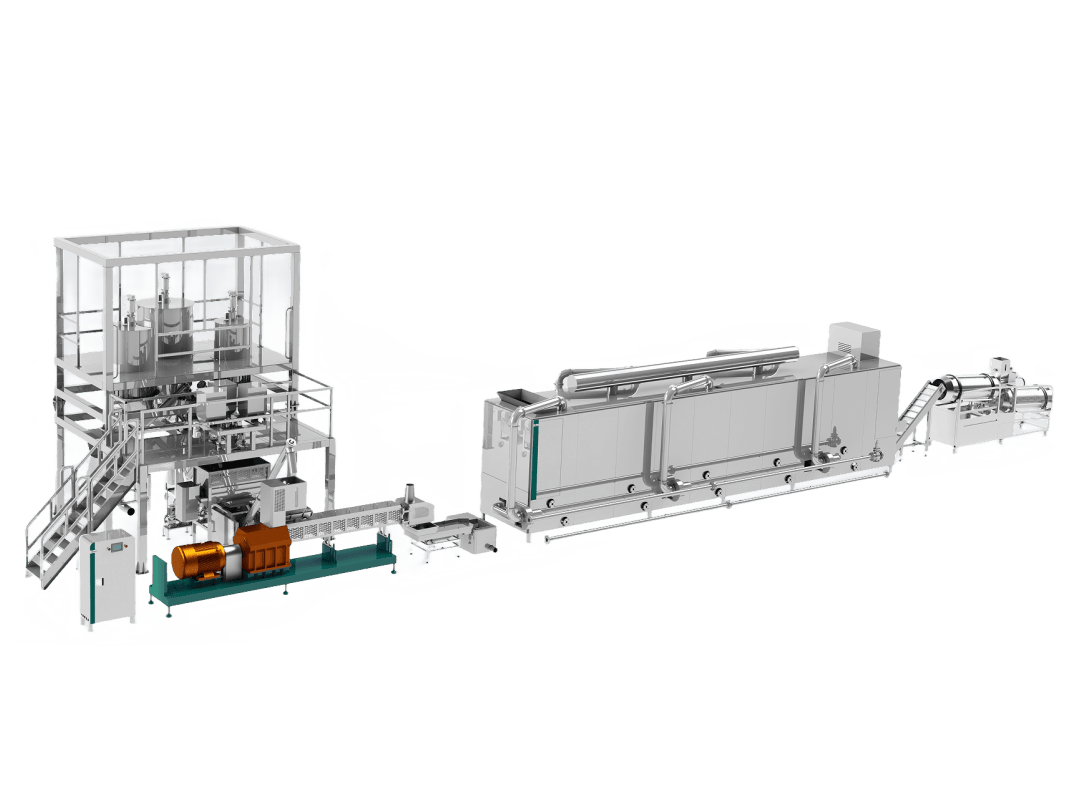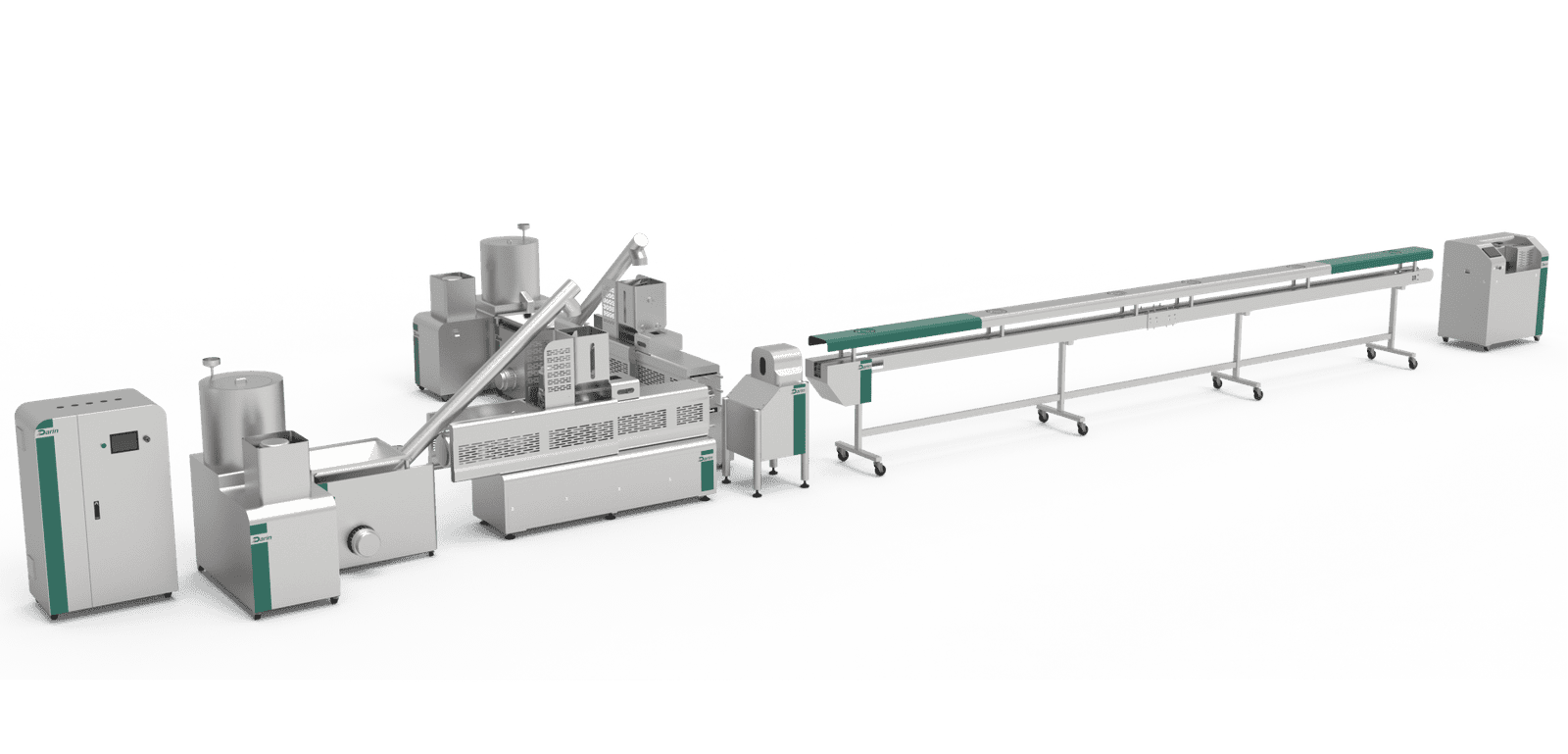
An automatic dog chews production line (also called an automatic dental treats processing line) connects seven stages — mixing, extrusion, cooling, cutting, oven feeding, drying and rotary-disc counting and packing — into one continuous process. One reference configuration runs at 200 kg/h with only 3–5 operators, compared with the heavy manual feeding, placing and tray-arranging that traditional lines depend on.
What Is an Automatic Dog Chews Production Line?
An automatic dog chews production line is a complete, connected system for making pet chews and dental sticks. Raw material goes in at one end, and finished, counted, neatly arranged product comes out at the other, without workers having to carry, place or sort the product between stages.
Darin is a professional manufacturer of pet food processing equipment. The line described in this article is Darin's fully automatic configuration, covering every step from batching to packing.
Buyers search for this equipment under many names. The most common are:
- Automatic Dental Treats Processing Line
- Automatic Dog Chews Production Line
- Dog Dental Stick Production Line
- Pet Dental Chew Making Machine
- Dog Chew Stick Manufacturing Line
- Automatic Dog Treat Extruder Line
- Dog Dental Care Chews Processing Line
- Pet Chews Production Line
Related terms include dental treats making machine, pet chews machine, dental sticks extruder machine, dog chew stick machine, dog treat extruder line and pet treats extruder machine. They all describe the same category: equipment that forms, dries and packs chew-type pet treats.
How the Automatic Line Works: 7 Steps from Raw Material to Packed Product
Step 1 — Ingredient mixing. Powder and liquid ingredients are blended into a uniform mixture. An automatic batching section handles this stage so the recipe is consistent from batch to batch.
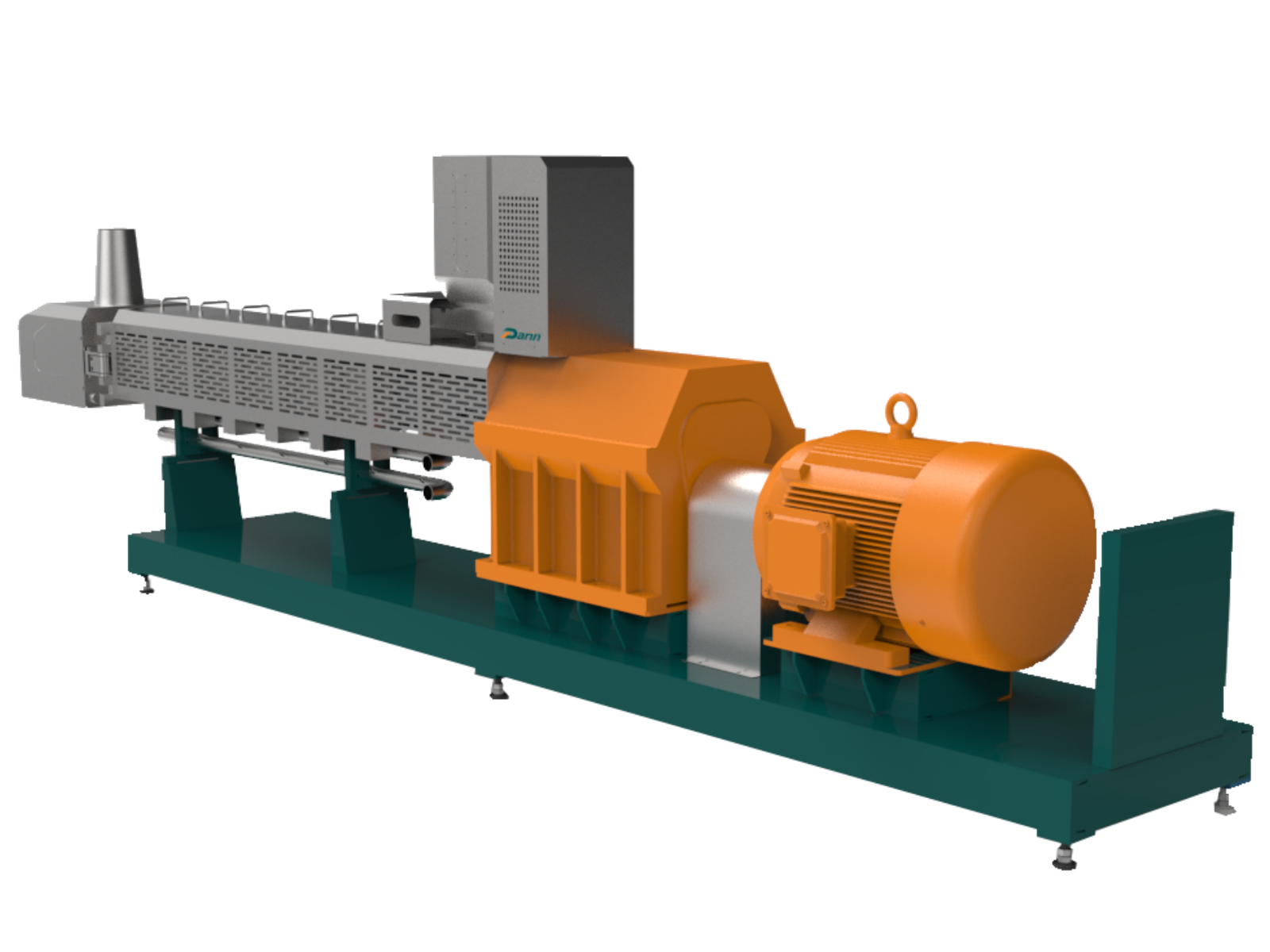
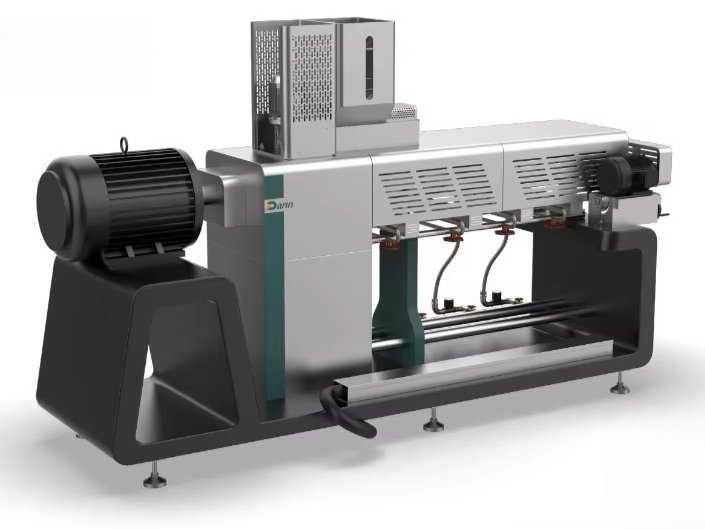
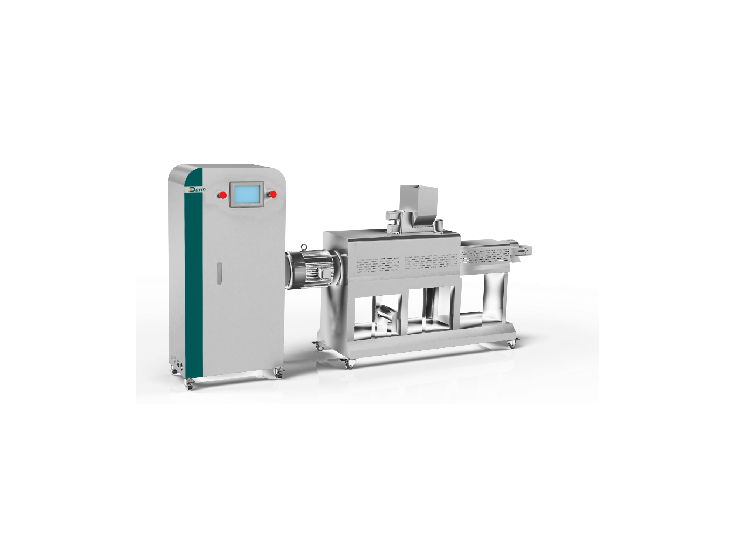
Step 2 — Extrusion and forming. The mixture is fed into the extruder, where the chew or dental stick is formed into its shape.
Step 3 — Cooling. The formed product is cooled so it holds its shape for the following stages.
Step 4 — Fixed-length cutting. The product is cut to a set length, which keeps size consistent across the batch.
Step 5 — Telescopic conveying into the oven. A telescopic conveyor carries the cut product automatically into the oven. No one has to place sticks by hand.
Step 6 — Oven drying. The product is dried in the oven to the required finish.
Step 7 — Rotary-disc arranging, counting and packing. An automatic rotary disc arranges and counts the product, then passes it into packing. Operators only watch the product and remove pieces with unqualified shapes at this stage.
The Problem with Non-Automatic (Manual) Production
Many pet treat factories still rely on workers for feeding, placing and tray arrangement. This creates six recurring problems:
- Low output and long lead times. Manual feeding and stick placement limit speed, so large orders take longer to deliver.
- Inconsistent quality. Uneven manual positioning leads to variation in product length and meat-wrapping thickness. Appearance is unstable and the defect rate is high.
- Labor intensity and turnover. Repetitive work tires workers, staff turnover is high, and skilled workers are costly to hire and manage.
- Food hygiene risk. Arranging trays by hand means direct hand contact with the product, which makes it harder to meet export food hygiene requirements.
- Counting errors and rework. Manual counting is error-prone, and messy trays must be re-sorted before packaging, which wastes working hours.
- Dependence on worker experience. Changing recipe or specification takes a long time to adjust, and quality differs noticeably between batches.
Manual vs. Automatic: Side-by-Side Comparison
| Factor | Manual / Semi-Manual Production | Automatic Production Line |
|---|---|---|
| Output | Limited by worker speed; long lead time on bulk orders | Higher capacity and stable delivery of large orders |
| Product consistency | Length and meat-wrap thickness vary; high defect rate | Uniform product positioning; better consistency; lower defect rate |
| Labor | Many repetitive positions; fatigue and turnover | Fewer repetitive jobs; less dependence on worker skill and staff turnover |
| Hygiene | Hands touch product during tray arranging | Less direct hand contact; easier to meet export food safety requirements |
| Counting and tray layout | Error-prone counting; trays need re-sorting | Automatic counting and neat arrangement; ready for packaging, no secondary sorting |
| Batch quality | Depends on worker experience | More stable and repeatable |
Key Advantages of a Fully Automatic Line
- Higher capacity and reliable bulk delivery. The line is built to keep large orders on schedule.
- Consistent finished product. Uniform positioning gives better consistency and fewer rejects.
- Lower labor pressure. Fewer repetitive jobs means production depends less on worker skill and staff turnover.
- Better hygiene. Less direct hand contact with material improves workshop conditions and helps meet export food safety requirements.
- Packing-ready output. Automatic counting and orderly arrangement put finished product on trays that connect straight to packaging, with no second sorting step.
Technical Specifications (Reference Configuration)
| Parameter | Value |
|---|---|
| Product type | Pet chews (dog chews, dental sticks) |
| Application | Pet snack processing, pet food industry |
| Capacity | 200 kg/h |
| Power | 120–150 kW |
| Voltage | 380 V / 50 Hz, three-phase (customizable) |
| Floor space | 25 × 5 × 4.5 m |
| Automation level | Fully automatic from batching to final packing |
| Labor required | 3–5 workers |
Labor breakdown: 1–2 workers at the raw material feeding and extrusion/cutting sections, 1 worker at the oven front feeding section, and 1 worker at the packing section. Workers mainly observe the product and remove pieces with unqualified shapes at packing.
Customer Case: Serbia
A Darin customer in Serbia purchased the automatic batching section, the automatic oven feeding section and the automatic packing section. Together these made the whole process fully automatic. Only a few workers are needed beside the machines for assistance, which greatly reduced labor.
Frequently Asked Questions
What is an automatic dog chews production line?
It is a connected system that mixes, extrudes, cools, cuts, dries, counts and packs dog chews and dental sticks with minimal manual handling.
What are the main steps in dog chew production?
Mixing, extrusion forming, cooling, fixed-length cutting, automatic feeding into the oven, oven drying, and rotary-disc arranging, counting and packing.
How much can the line produce?
The reference configuration has a capacity of 200 kg/h.
How many workers does the line need?
3–5 workers in total across feeding, extrusion and cutting, oven front feeding, and packing.
How much space and power does it need?
About 25 × 5 × 4.5 m of floor space and 120–150 kW, on 380 V / 50 Hz three-phase power. Voltage can be customized.
Can I buy only part of the line?
Yes. The Serbian customer bought the automatic batching, oven feeding and packing sections to complete the automation of their process.
Who is Darin?
Darin is a professional manufacturer of pet food processing equipment, supplying automatic dog chews production lines and individual sections such as batching, oven feeding and packing.
Why automate instead of using manual placement and tray arranging?
Automation addresses the limits of manual work: low output, inconsistent length and meat-wrap thickness, labor turnover, hand-contact hygiene risk, counting errors, and batch-to-batch quality variation.
Summary
Manual chew production is slow, inconsistent and hard to scale for export. A fully automatic dog chews production line from Darin joins mixing, extrusion, cooling, cutting, oven feeding, drying and packing into one flow. It delivers 200 kg/h with 3–5 workers, more uniform product, better hygiene and packing-ready trays.
*Darin – professional automatic pet food processing line manufacturer. Contact Darin to discuss an automatic dog chews production line for your factory. [Insert contact details and inquiry link here.]