In the fast-growing aquaculture industry, manufacturers face the challenge of producing high-quality, nutritionally balanced, and safe fish feed to meet the demands of fish farmers and the global seafood supply chain. Without a modern, well-engineered production system, companies risk inconsistent pellet size and texture, nutrient loss during processing, microbial contamination, and inefficient energy use. Over time, these problems can reduce fish growth performance, increase mortality rates, and damage brand reputation.
A fish feed production line solves these challenges by integrating automated, synchronized machinery to handle every stage — from ingredient reception to final packaging — with precision, hygiene, and cost efficiency. It ensures every batch meets exact nutritional profiles, pellet durability standards, and international food safety regulations.
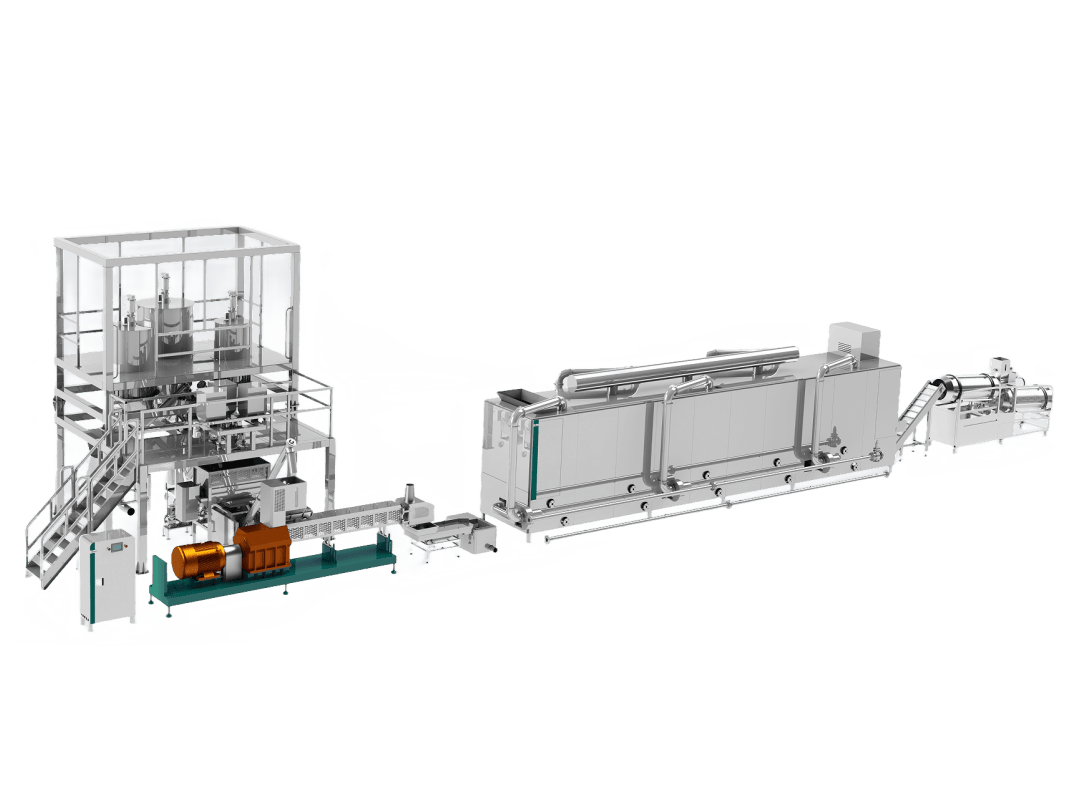
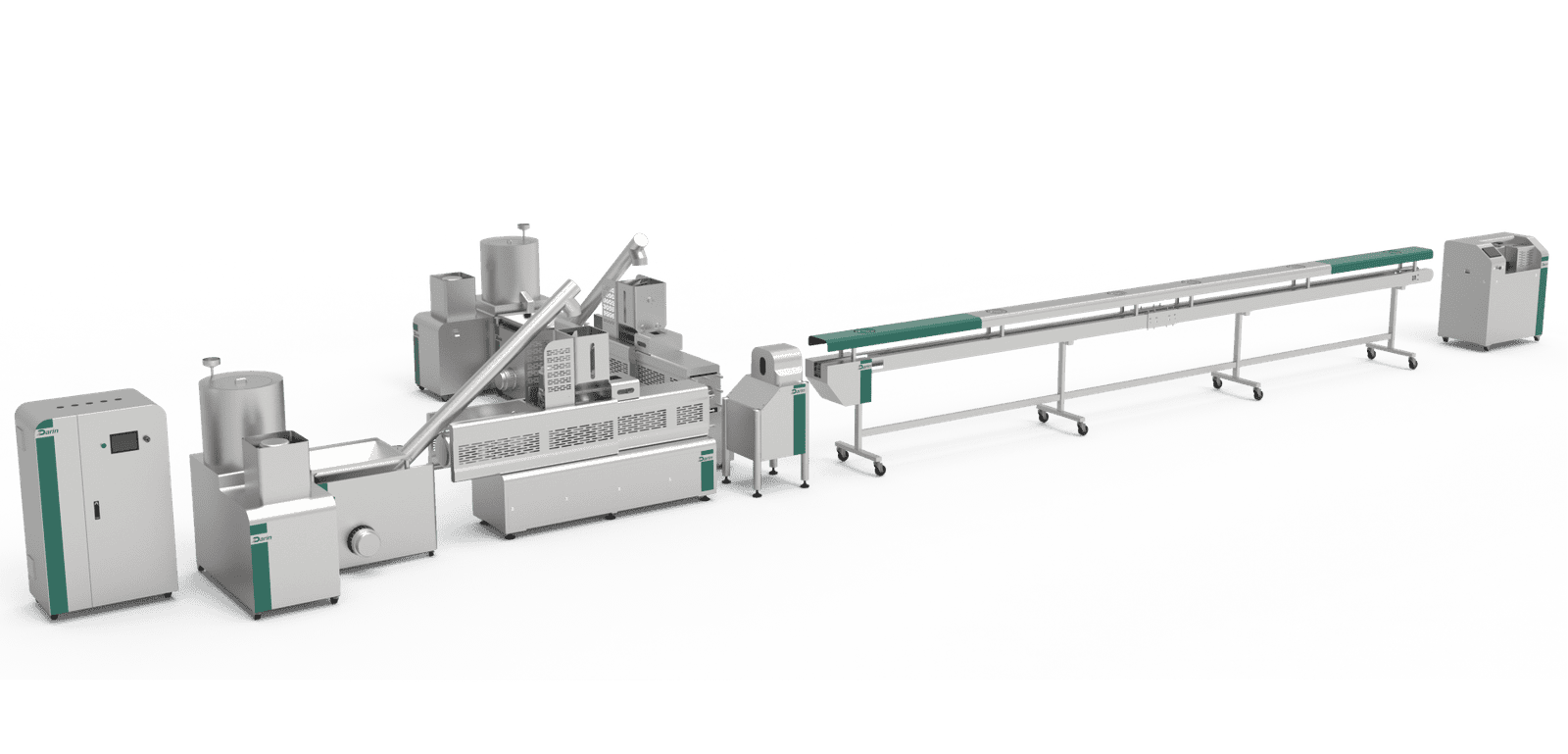
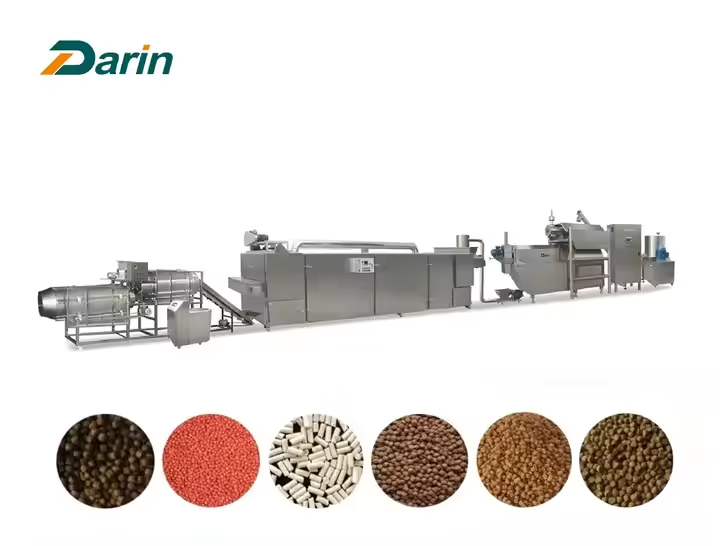
A fish feed production line is a coordinated system of industrial machines designed to convert raw ingredients — such as fish meal, soybean meal, grains, oils, vitamins, and minerals — into finished floating, sinking, or slow-sinking fish feed pellets through controlled processes. These include ingredient storage and grinding, mixing, pre-conditioning, extrusion or pelleting, drying, coating, cooling, and automated packaging. Each stage is engineered to optimize feed conversion ratios (FCR), pellet water stability, and compliance with aquaculture feed regulations such as GMP+, ISO, and HACCP.
For aquafeed manufacturers, understanding how a fish feed production line works is essential not only for meeting market demands but also for achieving high efficiency, product consistency, and compliance with global standards. In the next sections, we will explore the entire production process in detail, review key equipment and parameters, and share Darin Machinery’s real-world implementations for different scales of fish feed production.
Fish feed production lines can only produce floating feed pellets.False
Modern fish feed production lines can produce floating, sinking, and slow-sinking pellets by adjusting extrusion or pelleting parameters and formulations.
1. Understanding the Fish Feed Production Line Concept
A fish feed production line is a fully integrated industrial system designed to transform raw materials — such as fish meal, soybean meal, corn, wheat, vegetable proteins, fish oil, vitamins, and minerals — into nutritionally balanced feed pellets that meet the needs of different fish species and growth stages.
It operates under precisely controlled temperature, pressure, moisture, and mechanical shear to achieve the required pellet density, durability, and nutritional retention.
Unlike small-scale manual feed processing, a modern automated line ensures:
- Consistent pellet size and quality
- Accurate nutrient dosage
- High throughput with minimal waste
- Compliance with aquafeed safety regulations
By adjusting formulations, process parameters, and equipment configurations, a single production line can produce:
- Floating feed (for species like tilapia, catfish)
- Sinking feed (for shrimp, bottom feeders)
- Slow-sinking feed (for certain marine fish)
2. Main Categories of Fish Feed & Their Processing Differences
| Feed Type | Bulk Density | Common Species | Feeding Method | Key Processing Method | Market Share |
|---|---|---|---|---|---|
| Floating Feed | 0.25–0.35 g/cm³ | Tilapia, catfish, trout | Surface feeding | Twin-screw extrusion with high expansion | \~60% |
| Slow-Sinking Feed | 0.45–0.55 g/cm³ | Marine fish, some carp | Mid-water feeding | Controlled extrusion or pelleting | \~20% |
| Sinking Feed | 0.60–0.70 g/cm³ | Shrimp, eel, bottom feeders | Bottom feeding | Pellet mill compaction or low-expansion extrusion | \~20% |
3. General Fish Feed Production Flow
While the specific method depends on pellet type, most modern fish feed production lines follow these core stages:
- Raw Material Reception & Storage – Bulk ingredients are received, inspected, and stored in silos or bins under moisture-controlled conditions.
- Grinding – Hammer mills or pulverizers reduce particle size for uniform mixing and better digestibility.
- Mixing – Dry ingredients are blended; liquids like fish oil and binders are added evenly.
- Pre-Conditioning – Steam and water injection hydrate and partially cook the mix, improving pellet expansion.
- Extrusion or Pelleting – Product is cooked, shaped, and density-adjusted to create floating, sinking, or slow-sinking pellets.
- Drying – Multi-layer dryers reduce moisture to safe storage levels (8–12%).
- Coating – Oils, vitamins, and attractants are applied for nutritional and palatability purposes.
- Cooling – Counterflow coolers bring pellets to ambient temperature.
- Packaging – Automatic packing systems fill and seal bags or bulk containers.
4. Workflow Differences by Pellet Type
| Step | Floating Feed | Slow-Sinking Feed | Sinking Feed |
|---|---|---|---|
| Grinding | Fine (0.4–0.6 mm) | Medium (0.6–0.8 mm) | Medium-coarse (0.8–1.2 mm) |
| Pre-Conditioning | High steam injection | Medium steam | Low steam |
| Extrusion/Pelleting | High temp & high shear for expansion | Moderate temp & shear | Low expansion, high compaction |
| Drying | Multi-zone to prevent cracks | Gentle drying | Gentle drying |
| Coating | Post-extrusion oil & vitamin spray | Same as floating | Same as floating |
| Density Target | 0.25–0.35 g/cm³ | 0.45–0.55 g/cm³ | 0.60–0.70 g/cm³ |
5. Example: Floating Fish Feed Production Flow (Tilapia)
- Ingredient Storage – Stainless steel silos for fish meal, soybean meal, and grains.
- Grinding – Hammer mill with 0.5 mm screen for fine particles.
- Mixing – Ribbon mixer with liquid addition ports for fish oil and molasses.
- Pre-Conditioning – Double-shaft pre-conditioner with 2–3 bar steam injection.
- Extrusion – Twin-screw extruder at 120–150°C with adjustable screw profile for high expansion.
- Drying – Multi-layer dryer to reduce moisture to 9–10%.
- Coating – Vacuum coater applies fish oil and vitamins.
- Cooling – Counterflow cooler to ambient temperature.
- Packaging – Automatic bagging machine for 20–25 kg bags.
6. Key Equipment in a Fish Feed Production Line
A modern fish feed production line consists of specialized machinery, each optimized for a specific stage. Selecting the right equipment capacity, configuration, and control system is crucial for production efficiency, pellet quality, and operational costs.
6.1 Core Equipment Overview
| Machine | Function | Capacity Range | Power (kW) | Material | Key Features | Typical Lifespan |
|---|---|---|---|---|---|---|
| Silo & Storage Bin | Raw material storage | 5–50 m³ | N/A | SS304 or coated steel | Moisture control, pest-proof | 15+ years |
| Hammer Mill / Pulverizer | Particle size reduction | 500–8,000 kg/h | 22–132 | SS304 contact parts | Magnet separator, dust filter | 8–12 years |
| Ribbon Mixer | Dry ingredient blending | 500–3,000 kg/batch | 7.5–22 | SS304 | Liquid addition nozzles | 10+ years |
| Double-Shaft Paddle Mixer | High-moisture or oil-rich mixing | 300–2,500 kg/batch | 7.5–18 | SS304 | Gentle mixing, uniform coating | 10+ years |
| Pre-Conditioner | Hydration & partial cooking | 500–6,000 kg/h | 5–15 | SS304 | Steam/water injection | 12+ years |
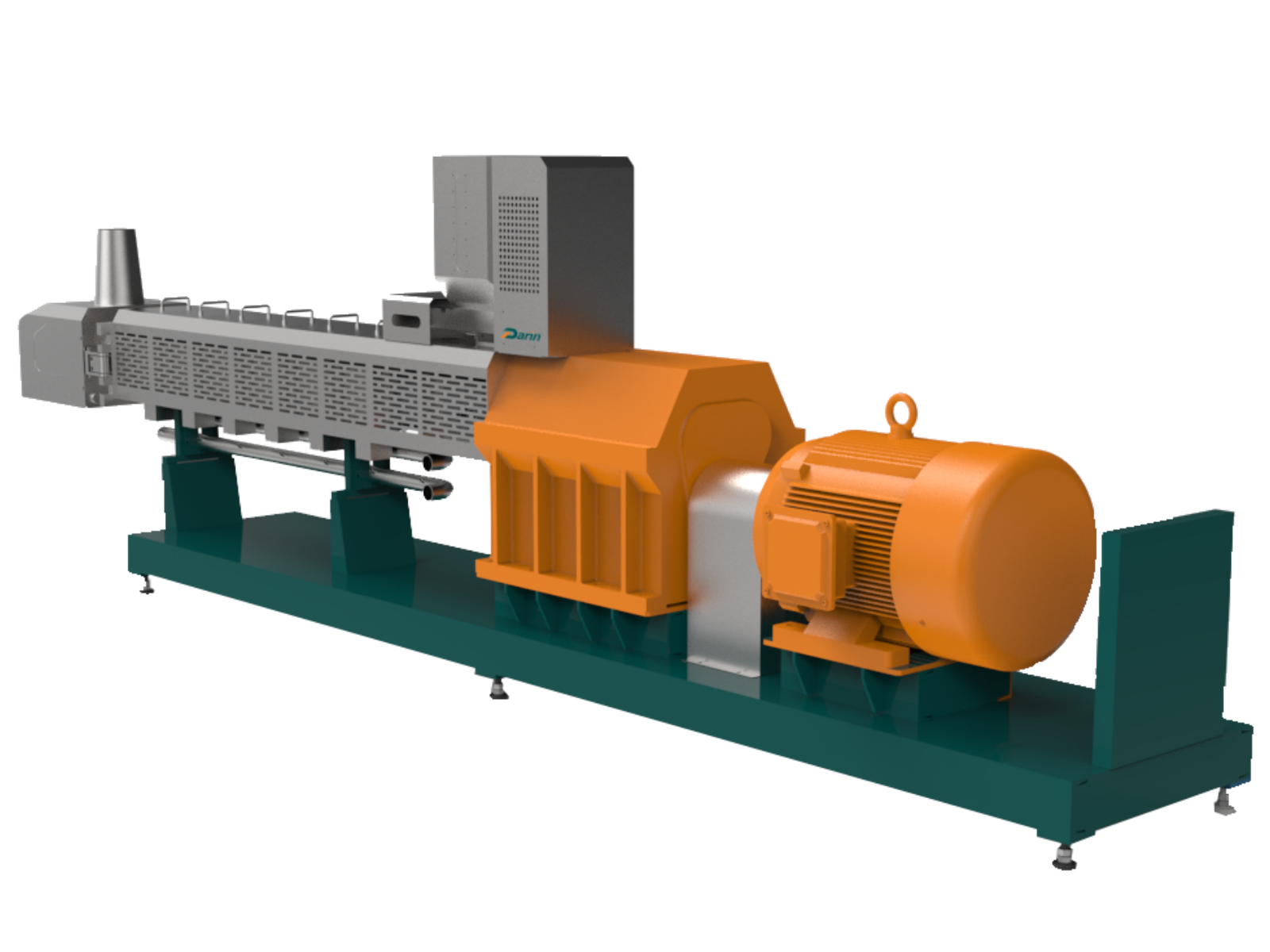
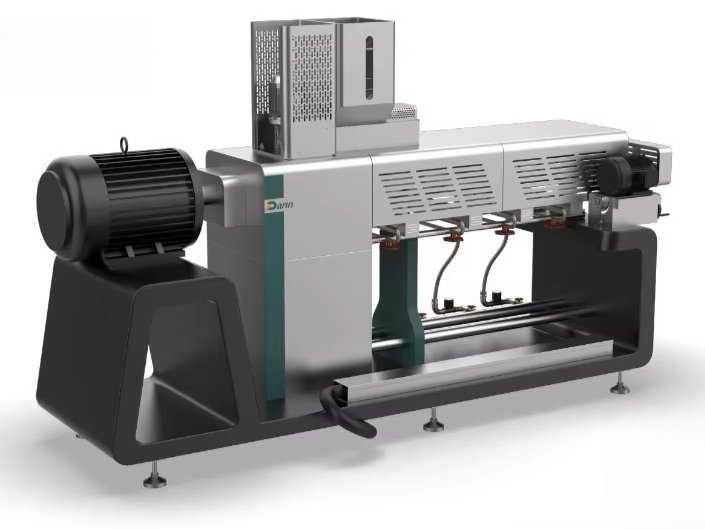
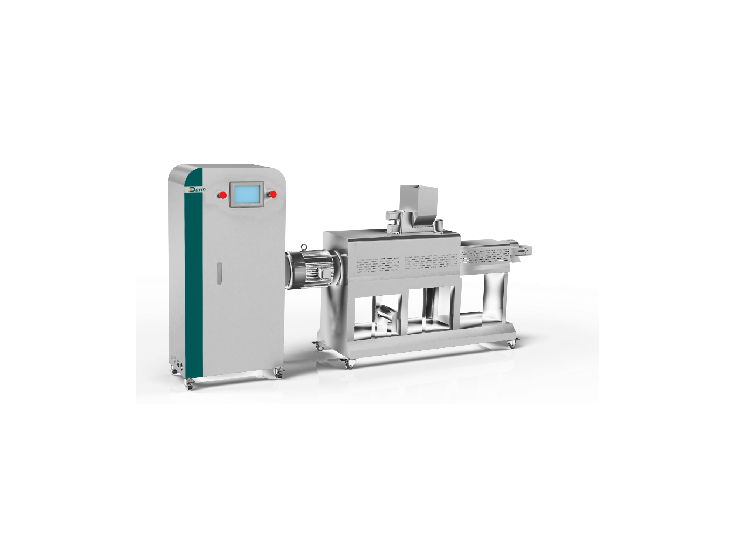
| Twin-Screw Extruder | Pellet shaping & cooking | 200–8,000 kg/h | 45–200 | SS304 barrel, hardened screws | PLC control, density adjustment | 15+ years |
| Pellet Mill | High-compaction pelletizing (sinking feed) | 500–6,000 kg/h | 37–132 | SS304 | Die change system | 12+ years |
| Multi-Layer Dryer | Moisture reduction | 500–10,000 kg/h | 15–90 | SS304 belts/trays | Multi-zone temperature control | 15+ years |
| Vacuum Coater | Oil/vitamin infusion | 500–4,000 kg/h | 7.5–18 | SS304 | ±0.1% dosing accuracy | 12+ years |
| Counterflow Cooler | Temperature reduction | 500–10,000 kg/h | 3–12 | SS304 | Gentle cooling, uniform airflow | 12+ years |
| Automatic Packer | Bag/pouch filling | 15–60 bags/min | 3–12 | SS304 | Servo drive, multi-head weigher | 10+ years |
7. Process Parameters by Feed Type
Precise control of process parameters ensures optimal pellet durability, water stability, and nutrient retention.
7.1 Floating Fish Feed
| Stage | Control Parameter | Target Value |
|---|---|---|
| Grinding | Particle size | 0.4–0.6 mm |
| Pre-conditioning | Moisture | 25–28% |
| Extrusion | Barrel temp | 120–150°C |
| Drying | Final moisture | 9–10% |
| Density | Bulk density | 0.25–0.35 g/cm³ |
7.2 Slow-Sinking Fish Feed
| Stage | Control Parameter | Target Value |
|---|---|---|
| Grinding | Particle size | 0.6–0.8 mm |
| Pre-conditioning | Moisture | 22–25% |
| Extrusion | Barrel temp | 105–130°C |
| Drying | Final moisture | 10–11% |
| Density | Bulk density | 0.45–0.55 g/cm³ |
7.3 Sinking Fish Feed
| Stage | Control Parameter | Target Value |
|---|---|---|
| Grinding | Particle size | 0.8–1.2 mm |
| Pelleting | Die compression ratio | 10–12:1 |
| Drying | Final moisture | 10–12% |
| Density | Bulk density | 0.60–0.70 g/cm³ |
8. Investment Cost & ROI Analysis
The cost of a fish feed production line depends on capacity, automation, and pellet type flexibility.
| Plant Size | Capacity | Estimated CapEx (USD) | OpEx (USD/h) | Payback Period |
|---|---|---|---|---|
| Small | 1 t/h | 240k–330k | 110–170 | 2.5–3 yrs |
| Medium | 3 t/h | 420k–610k | 260–330 | 2–2.5 yrs |
| Large | 5+ t/h | 680k–920k | 380–520 | 1.5–2 yrs |
9. Darin Machinery Global Case Studies
Case Study 1 – 4 t/h Floating Feed Line in Vietnam
- Challenge: High feed conversion ratio (FCR) in tilapia farms
- Solution: Installed twin-screw extruder with density control system and vacuum coater for oil application
- CapEx: USD 720,000
- Result: Reduced FCR from 1.7 to 1.5, saving 12% feed cost annually
- Payback Period: 1.8 years
Case Study 2 – 2.5 t/h Sinking Feed Line in Ecuador
- Challenge: Pellets breaking during shrimp feeding
- Solution: Added pellet mill with optimized die compression ratio and gentle dryer settings
- CapEx: USD 530,000
- Result: Pellet durability index (PDI) increased from 85% to 94%
- Payback Period: 2.1 years
10. Quality Control & Compliance in Fish Feed Production
Producing high-quality fish feed is not only about making pellets that look uniform — it’s about ensuring safety, nutritional consistency, and regulatory compliance. Darin Machinery’s fish feed lines are designed to comply with GMP+, ISO 22000, HACCP, and CE standards, enabling global market access.
10.1 Critical Control Points (CCPs)
| Stage | Risk | Control Method |
|---|---|---|
| Raw Material Reception | Contaminants, mold | Lab testing, magnetic separation, sieving |
| Grinding | Metal fragments | Inline magnets & sieves |
| Extrusion/Pelleting | Undercooked feed | Temperature, moisture, and pressure monitoring |
| Drying | Excess moisture | Inline moisture sensors |
| Coating | Over/under dosing | Automated dosing control |
| Packaging | Seal failures | Vision inspection systems |
10.2 Product Testing & Documentation
- Nutritional Analysis: Protein, fat, fiber, ash, moisture
- Physical Quality: Pellet durability index (PDI), water stability test (2–6 hours depending on pellet type)
- Microbiological Tests: Salmonella, E. coli, molds, yeasts
- Traceability: Full batch record from ingredients to finished product shipment
11. Maintenance & Troubleshooting Guide
A preventive maintenance plan helps maximize uptime and reduce costly breakdowns.
11.1 Preventive Maintenance Schedule
| Equipment | Daily | Weekly | Monthly |
|---|---|---|---|
| Extruder | Clean die/barrel | Inspect screw wear | Replace worn screws/dies |
| Pellet Mill | Clean die/rollers | Check lubrication | Inspect die compression |
| Dryer | Remove fines | Inspect belts/trays | Check motor bearings |
| Coater | Flush oil lines | Calibrate nozzles | Inspect seals |
| Cooler | Check airflow | Remove fines | Inspect discharge gates |
11.2 Common Issues & Solutions
| Issue | Likely Cause | Solution |
|---|---|---|
| Pellets too soft | Low extrusion temp or insufficient drying | Increase cooking temperature or drying time |
| Uneven pellet size | Worn die or poor feed distribution | Replace die, adjust feeder |
| Poor water stability | Incorrect formulation or low binder | Adjust recipe or increase binder level |
| Packaging seal failures | Low heat or contamination | Increase sealing temperature, clean sealing jaws |
12. Frequently Asked Questions (FAQ)
Q1: Can one production line make floating, sinking, and slow-sinking feed?
Yes, with a modular design and adjustable process parameters, Darin lines can produce all three pellet types on a single line.
Q2: How long does installation take?
On average, 1–8 weeks for installation and commissioning, depending on plant size and automation level.
Q3: What is the typical ROI for a Darin fish feed line?
Most customers achieve payback within 1.5–3 years.
13. Future Trends in Fish Feed Production
The aquafeed industry is moving toward:
- IoT-enabled monitoring for real-time control and predictive maintenance
- AI-based formulation optimization to reduce costs while maintaining quality
- Sustainable feed ingredients like insect meal, algae, and single-cell proteins
- Energy-efficient dryers to reduce OpEx
- Automated bulk packaging for large-scale farms
Your Next Steps to a Successful Fish Feed Plant
By now, you’ve seen how a well-designed fish feed production line can transform raw ingredients into consistent, high-performance feed that drives better growth rates, improves feed conversion ratios, and builds trust with your customers.
The difference between a basic setup and a fully optimized line is more than just machinery — it’s about process integration, quality control, and long-term reliability.
This is where Darin Machinery brings a real advantage. With proven experience across floating, slow-sinking, and sinking feed lines, we combine engineering precision, compliance-ready designs, and energy-efficient technology to help you scale production and profitability. Whether you’re launching a new facility or upgrading an existing one, we’ll work with you from concept to commissioning, ensuring every step supports your business goals.
Take the First Step Today
📞 Contact Darin Machinery now to discuss your fish feed production goals and get a custom-engineered solution tailored to your capacity, recipe, and market.
🌐 Visit: https://petreatsmachine.com
📧 Email: darin4@darin.cn