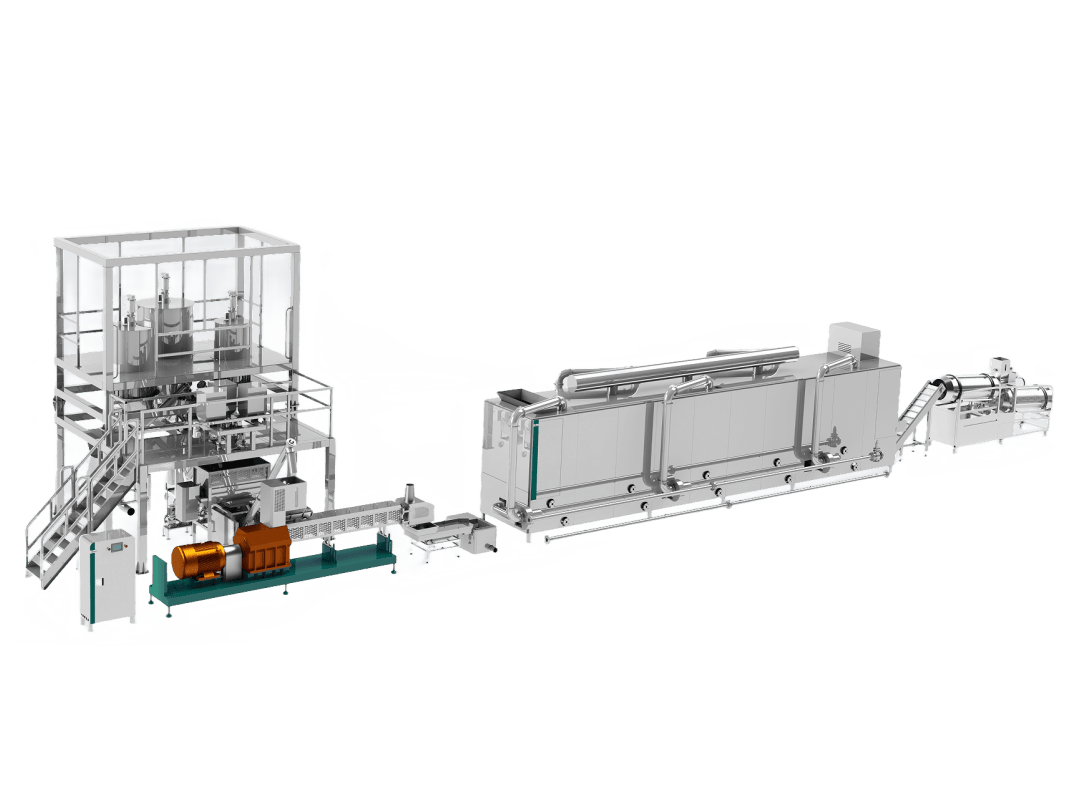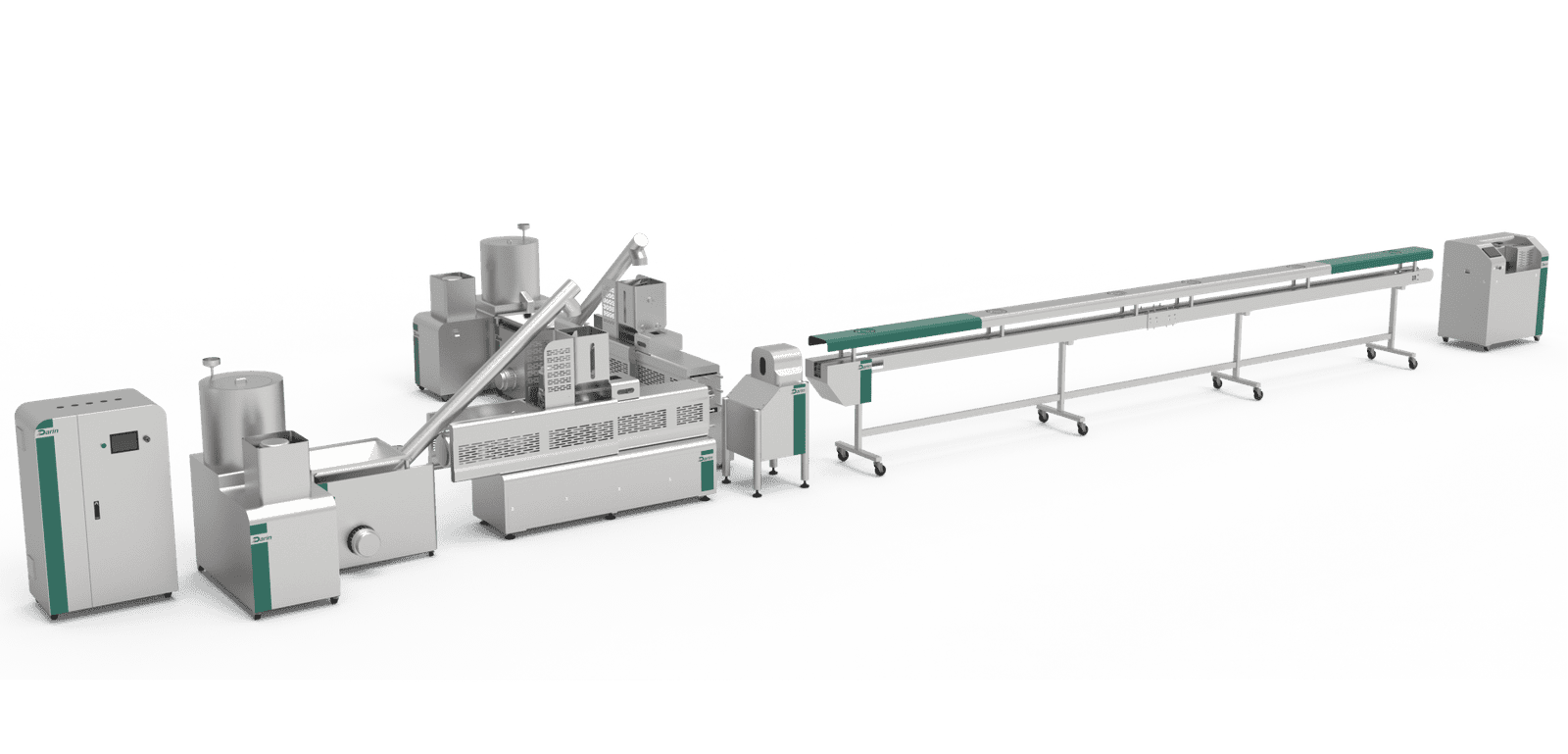

The pet treats industry is one of the fastest-growing sectors within global pet food. With dogs increasingly considered members of the family, owners are more willing to spend on high-quality snacks. Beef jerky treats stand out because of their high protein content, chewy texture, and natural appeal. Yet, many small and mid-sized producers struggle with challenges such as inconsistent texture, microbial risks, limited scalability, and high labor costs. These challenges can slow down growth or even prevent entry into lucrative export markets. The solution is adopting an automated dog treats beef jerky production line, which ensures consistent quality, safety, and cost-efficient large-scale production.
A dog treats beef jerky production line is a fully automated system designed to process raw beef or beef formulations into jerky-style snacks for dogs. It integrates grinding, mixing, forming or extruding, drying, cooling, and packaging. With automation, manufacturers achieve uniformity, meet strict pet food safety standards, reduce costs, and scale production from 100 kg/day to over 3,000 kg/day.
For investors, pet food manufacturers, and entrepreneurs, understanding this process is key to making strategic decisions about entering or expanding in the pet treats sector.
Dog jerky treats can be produced without specialized drying equipment and still remain safe for commercial sale.False
Controlled dehydration is essential to ensure safety, prevent microbial growth, and achieve shelf-stable jerky for retail markets.
Automated dog jerky treat production lines can cut labor requirements by over 50% compared to manual processes.True
Automation reduces manual handling, ensures batch consistency, and allows scaling with fewer workers.
Part 1 – Introduction & Market Overview of Dog Treats Beef Jerky Production
Global Pet Treats Market Growth
The global pet food market surpassed USD 130 billion in 2024, with the pet treats category growing at a faster pace than staple pet food. Within this, jerky-style treats for dogs are one of the most dynamic categories, favored for their:
- High protein content (mimicking natural canine diets).
- Portability and shelf life (convenient for owners).
- Chewy texture (supports dental health).
- Palatability (dogs find jerky irresistible).
Market Data Highlights:
- North America: Largest market, with beef jerky treats a staple in premium brands.
- Europe: Rising demand for grain-free and “clean-label” jerky snacks.
- Asia-Pacific: Fastest-growing market, especially China, Japan, and South Korea.
- Middle East: Growing demand for halal-certified jerky treats.
👉 According to Euromonitor, the global jerky pet treats segment is expected to grow at 8–10% CAGR through 2030, outperforming most other pet snack formats.
Pain Points in Manual Pet Jerky Production
Despite strong demand, many producers still rely on manual or semi-automatic methods. This creates challenges such as:
- Inconsistent Quality – Manual slicing and drying cause uneven thickness and chewiness.
- Safety Risks – Without controlled dehydration, microbial growth can lead to recalls.
- Limited Scale – Small-batch drying and manual packing restrict volume.
- High Labor Costs – Manual cutting, marinating, and packaging increase expenses.
- Export Barriers – FDA, AAFCO, and EU compliance require precision that manual processes cannot guarantee.
These issues prevent small and medium manufacturers from scaling profitably.
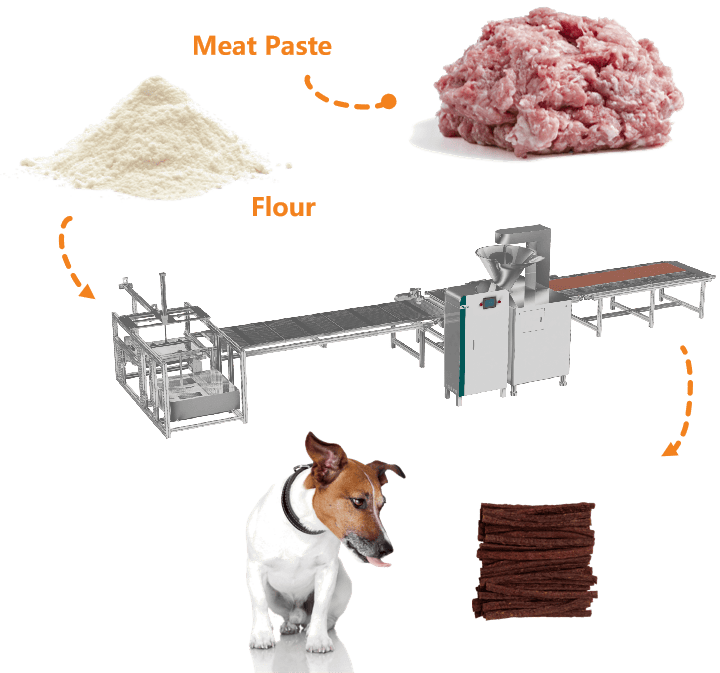
Why Invest in Automated Dog Jerky Treat Production Lines?
Automation addresses the above pain points with measurable benefits:
- Consistency: Standardized extrusion and drying ensure every batch has the same texture.
- Scalability: Output ranges from 100 kg/day for startups to 3,000+ kg/day for industrial plants.
- Safety & Compliance: Automated systems comply with AAFCO, FDA, EU, ISO, HACCP standards.
- Efficiency: Labor reduced by 50–60%, energy optimized through modern dryers.
- Market Reach: Enables access to export markets in North America, EU, and Asia.
👉 For entrepreneurs, this is not only a production upgrade but a strategic move to compete in global markets.
General Workflow of a Dog Jerky Treat Production Line
| Stage | Process | Key Equipment |
|---|---|---|
| 1. Meat Preparation | Grinding and deboning beef or beef blends | Meat grinder, slicer |
| 2. Mixing | Blending with palatability enhancers and binders | Vacuum mixer, ribbon blender |
| 3. Forming | Extruding into strips, sticks, or bone-shaped jerky | Twin-screw extruder, jerky former |
| 4. Drying | Dehydration to reduce water activity (aw <0.85) | Hot air dryer, microwave dryer |
| 5. Cooling | Prevents condensation and spoilage | Cooling conveyors |
| 6. Packaging | Vacuum sealing or MAP for shelf life | Vacuum packer, MAP machine |
This workflow is adaptable to multiple protein sources: beef, chicken, fish, or plant-based jerky for dogs.
Segmentation of Dog Jerky Treat Products
Different jerky treat types appeal to different market segments:
| Type | Description | Market Demand |
|---|---|---|
| Beef Jerky Strips | Classic flat strips | High demand globally |
| Jerky Sticks | Cylindrical chewy sticks | Popular as training treats |
| Bone-Shaped Jerky | Extruded or molded into bone shapes | Premium branding |
| Soft Jerky | Partially dried for chewiness | Younger/older dogs |
| Freeze-Dried Jerky | Lightweight, nutrient-rich | Ultra-premium niche |
Manufacturers often diversify product lines to capture wider demand.
Compliance & Safety Considerations
Dog jerky treats must meet pet-specific regulations in addition to human food safety standards:
- AAFCO (U.S.) – Nutritional adequacy & labeling.
- FDA (U.S.) – Safety, sanitation, and ingredient approval.
- EU Pet Food Law – Traceability, hygiene, additives regulation.
- ISO 22000/FSSC 22000 – Food safety management.
- Halal/Kosher – For religious markets.
👉 Automated lines using stainless steel 304/316, CIP (clean-in-place) designs, and hygienic conveyors ensure compliance and simplify audits.
Transition to Technical Deep Dive
Part 1 has provided a high-level overview of market growth, challenges, workflow, and compliance. In Part 2, we will explore the core processing stages in detail—from meat selection and grinding to advanced drying technologies—so you’ll understand exactly how high-quality dog jerky treats are manufactured.
Part 2 – Core Processing Stages of Dog Treats Beef Jerky Production
In Part 1, we examined the global market landscape and workflow overview of dog jerky treats. Now, we will dive into the technical heart of the process: each stage that transforms raw beef into safe, palatable, and shelf-stable jerky snacks for dogs. Understanding these steps helps investors and manufacturers identify critical control points, select the right machinery, and maintain compliance with pet food standards.
Dog jerky treat production involves sequential stages: raw meat preparation, mixing and marination, forming/extrusion, drying, cooling, and packaging. Each stage requires precision to ensure consistent texture, safety, and palatability.
Step 1: Raw Meat Selection and Preparation
1.1 Meat Choice
- Beef Cuts: Lean cuts such as flank, round, or shoulder.
- By-products: Trimmings and offcuts can be used if processed hygienically.
- Blends: Beef mixed with chicken or fish for cost savings and palatability.
👉 Pet Food-Specific Consideration: Unlike human jerky, pet jerky can incorporate meat meals, organ meats (liver, heart), or binders (starch, vegetable protein) as long as AAFCO and EU standards are met.
1.2 Pre-Processing
- Deboning: Bones must be fully removed to prevent hazards.
- Fat Trimming: Excess fat accelerates rancidity. Target: <12% fat.
- Grinding: Meat is ground to fine or medium particles for extrusion.
Equipment Used
- Meat grinder (single/double-screw).
- Meat slicer for strip-style jerky.
- Dicer for uniform cubes (optional for specialty jerky).
| Protein Type | Moisture % | Typical Cuts | Processing Challenge |
|---|---|---|---|
| Beef | 70–75 | Round, flank | Oxidation if too fatty |
| Chicken | 72 | Breast/thigh | High microbial load |
| Fish | 68 | Salmon, tuna | Spoils quickly |
| Plant-based | 55–65 | Soy/pea isolates | Requires binders |
Fact: Using organ meats (e.g., liver powder) enhances palatability for dogs but requires precise drying to prevent odor issues.
Step 2: Mixing and Marination
Dogs are highly sensitive to smell and taste, making this step critical.
2.1 Ingredients Added
- Protein Base: Ground beef, beef meal.
- Palatants: Liver hydrolysates, yeast extracts, or natural flavor enhancers.
- Binders: Starch, wheat gluten, or pea protein (improves structure).
- Functional Additives: Vitamins, minerals, omega-3 oils.
- Preservatives: Natural (rosemary extract, citric acid) instead of artificial nitrites.
2.2 Mixing Methods
- Dry Mixing: For powdered additives.
- Vacuum Mixing: Ensures uniform distribution and oxygen removal.
- Vacuum Tumbling (Optional): Used for strips of natural beef jerky to enhance marinade penetration.
Equipment Used
- Ribbon blender (dry/wet mixes).
- Vacuum mixer (for sticky protein blends).
- Vacuum tumbler (for strip-style jerky).
| Method | Time | Yield Impact | Application |
|---|---|---|---|
| Ribbon Blender | 10–20 min | Neutral | Ground jerky |
| Vacuum Mixer | 15–30 min | +2–3% water retention | Extruded jerky |
| Vacuum Tumbling | 20–60 min | +3–5% marinade absorption | Natural beef jerky strips |
Fact: Palatability enhancers can increase consumer (dog) acceptance by up to 30% compared to untreated jerky.
Step 3: Forming & Extrusion
This stage defines the shape and format of jerky treats.
3.1 Types of Jerky Products
- Natural Strips – Cut directly from beef slices.
- Extruded Jerky – Ground meat extruded into strips, sticks, or bones.
- Molded Jerky – Hydraulic press shaping into 2D or 3D forms.
3.2 Extrusion Process
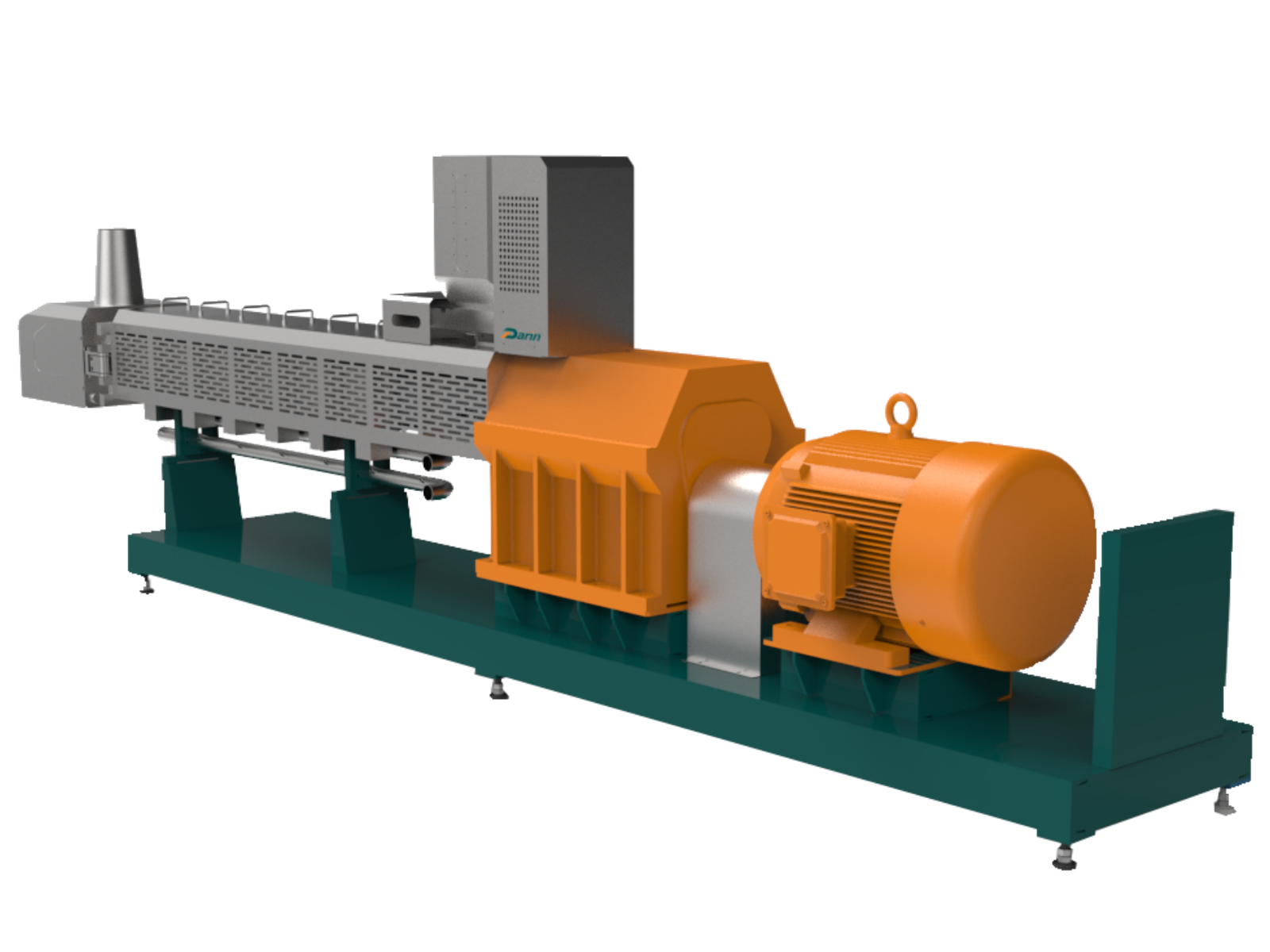
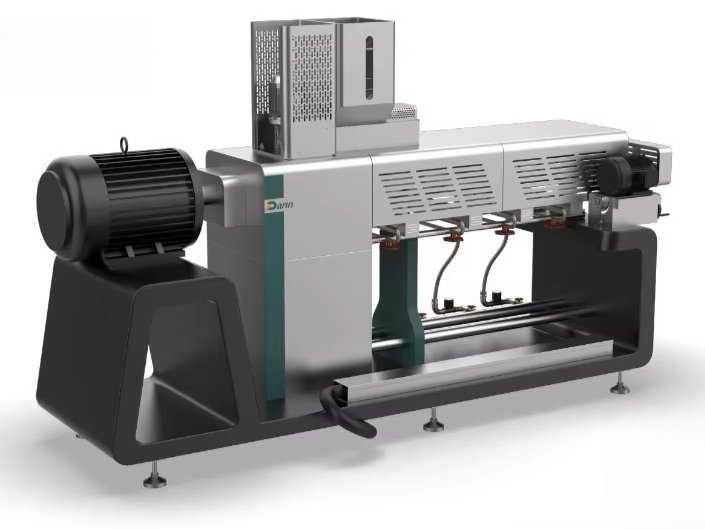
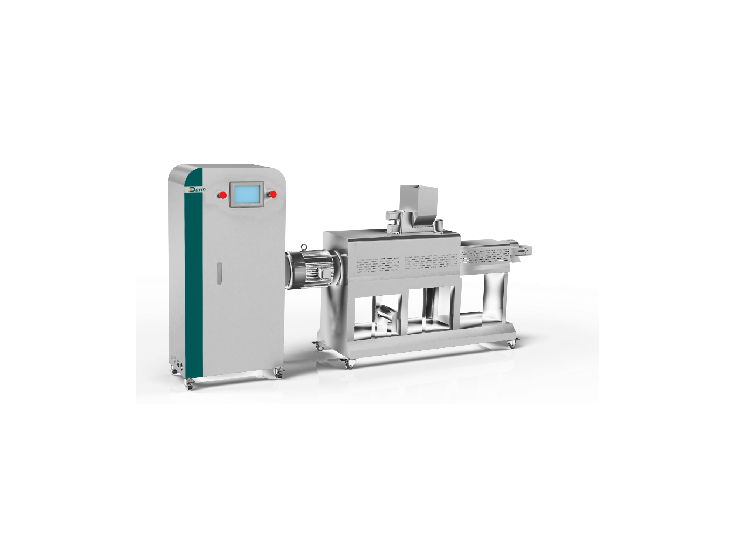
- Twin-Screw Extruder mixes, cooks (if required), and shapes jerky dough.
- Adjustable dies allow different shapes: strips, sticks, nuggets, bones.
- Cooking extrusion can pasteurize, improving safety.
Equipment Used
- Jerky extruder with interchangeable molds.
- Jerky press/former.
- Die sets for shapes (bone, paw, stick, strip).
| Product | Equipment | Advantage | Market Segment |
|---|---|---|---|
| Strips | Slicer + Dryer | Natural, premium appeal | Classic jerky |
| Sticks | Twin-screw extruder | Uniform, scalable | Training treats |
| Bones | Molding press | Creative branding | Premium/functional |
Fact: Extrusion allows up to 20% raw material savings by utilizing trimmings and secondary cuts.
Step 4: Drying & Dehydration
Drying is the critical control point: it ensures safety and shelf stability.
4.1 Target Parameters
- Water Activity (aw): <0.85 to prevent microbial growth.
- Moisture Content: 18–25% depending on product.
- Temperature: 55–75°C (hot air), 70–90°C (microwave).
4.2 Drying Technologies
-
Hot Air Drying
- Time: 6–12 hrs
- Texture: Chewy, traditional
- Equipment: Multi-layer conveyor dryer
-
Microwave Drying
- Time: 2–4 hrs
- Energy: More efficient
- Texture: Uniform dryness
-
Hybrid Drying
- Combines hot air + microwave
- Balanced efficiency and texture
-
Freeze-Drying (Premium)
- 12–24 hrs
- High cost, niche products
- Lightweight, nutrient-rich jerky
Comparative Table
| Method | Drying Time | Energy Use | Product Quality | Market Use |
|---|---|---|---|---|
| Hot Air | 6–12 hrs | Medium | Chewy, traditional | Mainstream |
| Microwave | 2–4 hrs | Low-medium | Uniform | Industrial scale |
| Hybrid | 3–6 hrs | Medium-low | Balanced | Mid-large plants |
| Freeze-Dry | 12–24 hrs | High | Premium, light texture | High-end niche |
Fact: Drying consumes 40–50% of total energy costs in jerky production—making efficient dryers vital to profitability.
Step 5: Cooling & Stabilization
Jerky must cool gradually before packaging to avoid condensation inside packs.
- Cooling Conveyors: Stainless steel belts with forced-air cooling.
- Chill Rooms: For larger batch stabilization.
👉 Improper cooling can cause mold growth even if drying was successful.
Step 6: Packaging
Packaging extends shelf life and enhances branding.
Packaging Types
- Vacuum Sealing – Removes oxygen, shelf life 6–12 months.
- Modified Atmosphere Packaging (MAP) – Nitrogen flush, shelf life 9–18 months.
- Resealable Pouches – Convenient for pet owners, 3–9 months shelf life.
Equipment Used
- Vacuum packer (single/double chamber).
- MAP sealing line.
- Flow wrapper for retail packs.
| Packaging Type | Shelf Life | Market Focus |
|---|---|---|
| Vacuum | 6–12 mo | Bulk/export |
| MAP | 9–18 mo | Premium retail/export |
| Resealable | 3–9 mo | Everyday consumer packs |
Fact: Premium jerky treats with MAP packaging and oxygen absorbers are exportable worldwide with shelf life up to 18 months.
Transition to Next Part
Part 2 detailed the core processing stages, from meat preparation to final packaging. Each stage contains critical control points that affect safety, yield, and palatability.
In Part 3, we will analyze the equipment configurations of dog jerky production lines in detail—comparing small, medium, and industrial setups, automation technologies, and real-world Darin Machinery case studies.
Part 3 – Equipment & Line Configurations of Dog Treats Beef Jerky Production
In Part 2, we walked through the core processing stages of dog jerky production, from meat preparation to packaging. Now, let’s zoom in on the equipment and configurations that make these stages possible. Whether you’re a small-scale startup or an industrial manufacturer, the design of your production line determines not only output and cost but also compliance, scalability, and product quality.
A dog treats beef jerky production line is a modular system of machines, customized for capacity and automation level. Each unit—from grinders to extruders, dryers, and packers—plays a critical role. Configurations vary depending on production scale, investment capacity, and target market (domestic retail vs. international exports).
Core Equipment in a Dog Jerky Treat Production Line
1. Meat Preparation Machinery
- Meat Grinder: Reduces beef into fine/medium mince, essential for extruded jerky.
- Meat Slicer: Cuts lean beef strips for natural-style jerky treats.
- Meat Dicer: Prepares uniform cubes (for jerky nuggets).
👉 Key Feature: High-capacity grinders (500–1,500 kg/h) with variable plate sizes allow flexibility between coarse-ground and fine-ground jerky products.
2. Mixing and Marination Systems
- Ribbon Blender: Blends ground beef with powders (palatants, vitamins).
- Vacuum Mixer: Enhances uniformity, removes oxygen pockets.
- Vacuum Tumbler: For natural beef jerky strips, allows marinade penetration.
👉 Key Feature: Vacuum mixing boosts water-binding capacity, improving yield by 3–5%.
3. Forming & Extrusion Machines
- Twin-Screw Extruder: Shapes ground beef into jerky sticks, strips, or bone shapes.
- Jerky Former/Press: Compresses dough into flat sheets or custom molds.
- Hydraulic Molding Press: Creates creative bone or paw shapes for premium branding.
👉 Key Feature: Extrusion allows utilization of trimmings and by-products, reducing raw material cost by 15–20%.
4. Drying Systems
Drying is the most critical—and energy-intensive—part of the line.
- Multi-Layer Hot Air Dryer: Continuous conveyor-based system, adjustable zones.
- Microwave Dryer: Accelerates drying, uniform moisture removal.
- Hybrid Dryer: Combines hot air + microwave, balancing cost and efficiency.
- Freeze-Dryer: For ultra-premium, lightweight jerky treats.
👉 Key Feature: IoT-enabled dryers monitor temperature, humidity, and moisture in real time, ensuring batch consistency.
5. Cooling Systems
- Cooling Conveyors: Stainless steel belt conveyors with forced air.
- Chill Rooms: For industrial plants with large batch cooling needs.
👉 Key Feature: Proper cooling avoids condensation inside packaging—a common cause of mold.
6. Packaging Equipment
- Vacuum Packer: Bulk jerky, export-ready.
- Modified Atmosphere Packaging (MAP): Injects nitrogen/CO₂ for long shelf life.
- Flow Wrapper: Flexible retail packaging with resealable options.
👉 Key Feature: MAP packaging extends shelf life to 9–18 months, opening global export markets.
Configurations by Production Scale
| Scale | Typical Configuration | Daily Output | Labor Requirement | Investment (USD) |
|---|---|---|---|---|
| Small Scale (Startups) | Grinder + Mixer + Extruder + Batch Dryer + Tabletop Packer | 100–300 kg | 5–8 | \$25,000–60,000 |
| Medium Scale (Growing Brands) | Grinder + Vacuum Mixer + Twin-Screw Extruder + Tunnel Dryer + MAP Packer | 500–1,500 kg | 10–15 | \$100,000–220,000 |
| Industrial Scale (Factories) | Automated grinders, robotic mixers, extrusion + hybrid dryers + robotic MAP packaging line | 3,000+ kg | 15–25 | \$350,000+ |
👉 Observation: Small-scale lines are affordable entry points, but medium and industrial setups provide the best ROI due to lower cost per kilogram of jerky.
Compliance & Hygiene Design
All equipment must comply with pet food and human food safety standards.
- Stainless Steel 304/316 – Corrosion-resistant, hygienic.
- CIP (Clean-in-Place) Systems – Automatic washing of mixers, tumblers, and dryers.
- Sealed Conveyors – Prevent contamination during transfer.
- Zoned Layouts – One-way flow: raw → processing → drying → packaging.
👉 Compliance Standards:
- AAFCO (U.S.) – Nutritional and ingredient approval.
- FDA (U.S.) – Processing, labeling, and microbial safety.
- EU (EC 1069/2009) – Pet food hygiene law.
- ISO 22000 / FSSC 22000 – Food safety management.
- Halal/Kosher Certification – Market-specific demand.
Case Studies of Darin Machinery Dog Jerky Lines
Case Study 1 – Medium-Scale Plant in Eastern Europe
- Setup: 1,200 kg/day line with twin-screw extruder + hybrid dryer.
-
Results:
- Labor reduced from 20 → 12 workers.
- Yield increased by 12% via vacuum mixing.
- Export approved for Germany & Middle East.
- ROI: 10 months.
Case Study 2 – Industrial Facility in Southeast Asia
- Setup: 3,500 kg/day fully automated jerky line with robotic packers.
-
Results:
- Energy cost reduced 25% via IoT-monitored hybrid dryers.
- Expanded to dual product line (dog treats + cat treats).
- Export markets: Japan, Korea, and EU.
- ROI: 8 months.
Visualization: Typical Dog Jerky Production Line Layout
| Section | Equipment Placement | Notes |
|---|---|---|
| Raw Zone | Grinder + Slicer + Cold Storage | Hygienic separation from processing |
| Mixing Zone | Ribbon Blender + Vacuum Mixer | CIP-enabled |
| Forming Zone | Twin-Screw Extruder + Molding Press | Automated conveyors link stages |
| Drying Zone | Hybrid Multi-Layer Dryer | Divided into temp/humidity zones |
| Cooling Zone | Conveyor with fans | Prevents condensation |
| Packaging Zone | MAP + Flow Wrapper | Dust-free, controlled air |
Transition to Next Part
We’ve now analyzed the equipment and configurations of dog jerky production lines, including real-world case studies and compliance standards.
In Part 4, we’ll explore the cost structure, ROI, and operational considerations—covering capital investment, operating costs, yield ratios, and profitability models. This will provide manufacturers with the financial framework to plan their investments strategically.
Part 4 – Cost Analysis, ROI & Operational Considerations for Dog Treats Beef Jerky Production
In Parts 1–3, we explored the market opportunities, core processing stages, and equipment configurations for dog jerky treat production. Now we move into the business-critical side: cost, profitability, and return on investment (ROI). For investors, this section is often the deciding factor in whether to move forward with a jerky treat production project.
A dog treats beef jerky production line requires an investment ranging from \$25,000 for a small-scale line to over \$350,000 for a fully automated industrial plant. Operating costs include raw meat, additives, labor, energy, packaging, and maintenance. With global demand growing, ROI is typically achieved within 9–15 months, and sometimes faster at scale.
Capital Investment Costs
The initial investment depends on scale and automation level.
| Scale | Equipment Included | Investment Range (USD) | Daily Output |
|---|---|---|---|
| Small-Scale | Grinder + Mixer + Extruder + Batch Dryer + Vacuum Packer | \$25,000 – \$60,000 | 100–300 kg |
| Medium-Scale | Grinder + Vacuum Mixer + Twin-Screw Extruder + Tunnel Dryer + MAP Packer | \$100,000 – \$220,000 | 500–1,500 kg |
| Industrial-Scale | Automated grinder, mixer, extrusion line + Hybrid Dryers + Robotic MAP Packaging | \$350,000+ | 3,000+ kg |
👉 Observation: Dryers and packaging machines are the most expensive modules, often accounting for 50–60% of total CAPEX.
Operating Costs Breakdown
Let’s break down the typical operating costs per kilogram of dog jerky treats:
| Cost Category | Small-Scale | Medium-Scale | Industrial-Scale |
|---|---|---|---|
| Raw Meat & Additives | \$4.00 | \$3.80 | \$3.50 |
| Palatants/Vitamins | \$0.50 | \$0.45 | \$0.40 |
| Labor | \$1.20 | \$0.60 | \$0.30 |
| Energy (Drying, Packaging) | \$1.00 | \$0.75 | \$0.55 |
| Packaging | \$0.40 | \$0.35 | \$0.30 |
| Maintenance | \$0.20 | \$0.18 | \$0.15 |
| Total Cost/kg | \$7.30 | \$6.13 | \$5.20 |
👉 Key Insight: Scaling reduces cost per kilogram significantly, mainly through lower labor and energy costs per unit.
Yield Ratios
Unlike standard food production, jerky production involves moisture loss:
- 100 kg raw beef → 35–40 kg jerky treats (due to dehydration).
- Yield ratio: \~35–40%.
This means raw material accounts for 60–70% of total cost. Efficiency improvements in drying and marination directly impact profitability.
| Factor | Effect on Yield | Notes |
|---|---|---|
| Vacuum Mixing | ↑ +2–3% | Better water retention |
| Proper Marination | ↑ +3–5% | Salt/sugar bind moisture |
| Hybrid Drying | Improves efficiency | Avoids case hardening |
| Leaner Meat | Higher yield | Less fat rendered away |
Selling Price & Market Margins
Dog jerky treats are premium-positioned products. Prices vary by market:
| Market | Retail Price (per kg) | Manufacturer B2B Price |
|---|---|---|
| North America | \$25–40 | \$15–22 |
| Europe | \$22–35 | \$14–20 |
| Asia-Pacific | \$18–28 | \$12–18 |
| Middle East | \$20–32 | \$13–19 |
👉 Manufacturers selling at B2B wholesale levels typically enjoy 30–50% gross margins depending on scale.
ROI Timeline Example
Let’s calculate ROI for a medium-scale facility:
- Investment: \$180,000
- Daily Output: 1,000 kg jerky treats
- Cost per kg: \$6.13
- Selling Price (B2B): \$16/kg
- Profit per kg: \$9.87
- Daily Profit: \$9,870
- Monthly Profit (22 working days): \$217,140
👉 Payback Period = \$180,000 ÷ \$217,140 ≈ 0.8 months
Even with distribution and logistics considered, ROI is achievable within 9–12 months.
Maintenance & Lifespan of Equipment
- Extruders: 10–12 years lifespan with proper maintenance.
- Dryers: 12–15 years.
- Packaging Systems: 8–10 years.
Annual maintenance typically costs 3–5% of equipment value. Preventive maintenance is essential to avoid downtime.
Labor vs. Automation Analysis
| Setup | Workers Needed | Output | Cost Impact |
|---|---|---|---|
| Manual Line | 20–25 | 200–300 kg/day | High labor, inconsistent |
| Semi-Automatic | 12–15 | 1,000 kg/day | Balanced |
| Fully Automated | 15–20 | 3,500+ kg/day | Low labor per unit |
Automation doesn’t eliminate labor but reduces reliance on skilled manual work, making scaling easier.
Quality Control & Certification Costs
To export, compliance is mandatory:
- HACCP – \$5,000–15,000.
- ISO 22000 / FSSC 22000 – \$10,000–30,000.
- AAFCO / FDA – For the U.S. market.
- Halal/Kosher – \$3,000–10,000 per audit.
Though they add cost, these certifications unlock premium export markets with higher margins.
Risk Factors
- Raw Meat Price Volatility – Beef costs can shift 10–20% annually.
- Energy Costs – Drying is energy-intensive; hybrid systems mitigate.
- Regulatory Delays – Export approvals may delay market entry.
- Market Competition – Premium brands drive price wars.
Mitigation Strategies: Diversify protein sources (beef, chicken, fish, plant-based) and invest in IoT-enabled dryers for energy savings.
Case Study – ROI of a Darin Medium Line in Asia
- Client: Southeast Asian pet food company.
- Setup: 1,200 kg/day extruder + hybrid dryer + MAP packaging.
-
Results:
- Labor reduced by 45%.
- Production cost dropped from \$6.90/kg → \$6.10/kg.
- Export approval gained for EU.
- ROI achieved in 10 months.
Transition to Next Part
Part 4 demonstrated the financial backbone of jerky production lines: investment ranges, operating costs, yield ratios, ROI, and risks.
In Part 5 – Future Trends & Conclusion, we’ll look at innovation shaping the industry: plant-based jerky, functional treats, freeze-dried snacks, smart automation, and global compliance. This will help manufacturers and investors future-proof their strategies.
Part 5 – Future Trends, Innovations & Conclusion for Dog Treats Beef Jerky Production
In Parts 1–4, we explored the market opportunity, processing stages, equipment setups, and cost/ROI considerations for dog treats beef jerky production. Now, let’s look ahead. The pet food industry is evolving rapidly, shaped by consumer preferences, regulatory pressures, and technological innovations. Manufacturers who anticipate these shifts will remain competitive and profitable.
The future of dog jerky treats will be driven by health-focused formulations, plant-based alternatives, smart automation, and sustainability. Manufacturers must align with these trends while ensuring compliance and scalability.
Trend 1: Functional & Health-Oriented Jerky Treats
Dog owners are increasingly aware of nutrition. Jerky treats are no longer just “snacks” but functional supplements.
- Joint Health Jerky – fortified with glucosamine and chondroitin.
- Skin & Coat Jerky – enriched with omega-3 fatty acids from fish oil.
- Dental Jerky – textured jerky designed to reduce tartar buildup.
- Hypoallergenic Jerky – formulated without common allergens (wheat, soy, chicken).
| Functional Jerky Type | Added Ingredient | Benefit for Dogs |
|---|---|---|
| Joint Health | Glucosamine, Chondroitin | Supports mobility |
| Skin & Coat | Fish oil, Omega-3 | Shiny coat, reduced shedding |
| Dental Chews | Calcium carbonate, fiber | Oral hygiene |
| Hypoallergenic | Novel proteins (duck, venison) | Reduces allergy risk |
👉 Opportunity: Premium pet owners are willing to pay 20–40% more for functional jerky treats.
Trend 2: Plant-Based & Alternative Protein Jerky
Sustainability concerns and dietary diversity are driving plant-based pet snacks.
- Protein Sources: Soy, pea protein, lentils, mushrooms, and insect protein.
- Market Growth: Plant-based pet treats are growing at CAGR 12–15%, outpacing traditional meat snacks.
- Advantages: Lower carbon footprint, appeals to eco-conscious owners.
👉 Equipment Compatibility: Darin twin-screw extruders can process both meat-based and plant-based jerky, allowing manufacturers to diversify without separate lines.
Trend 3: Freeze-Dried & Premium Jerky
Freeze-drying is emerging as a premium processing technology:
- Benefits: Locks in nutrients, light and crunchy texture, long shelf life.
- Market Segment: Niche but high-margin; popular in North America and Europe.
- Challenge: High equipment and energy costs.
👉 Positioning: Freeze-dried jerky is often marketed as a human-grade, ultra-premium treat.
Trend 4: Smart Automation & IoT
Automation is advancing beyond basic robotics.
- IoT-Enabled Dryers: Sensors monitor moisture in real time, preventing over- or under-drying.
- AI Optimization: Algorithms predict drying times and adjust airflow automatically.
- Energy Recovery Systems: Reuse waste heat, cutting drying costs by 15–20%.
- Robotic Packaging: Increases speed and reduces contamination risk.
👉 Case Example: A Darin Machinery client in Europe cut energy use by 22% with IoT dryers while increasing output consistency.
Trend 5: Sustainability in Production & Packaging
Pet owners are demanding eco-friendly solutions:
- Raw Materials: Use of responsibly sourced beef or alternative proteins.
- Energy Efficiency: Hybrid dryers and heat recovery systems.
- Packaging: Biodegradable films and recyclable pouches replacing plastics.
👉 Sustainable packaging can be a differentiator in premium retail chains.
Trend 6: Regulatory Pressures & Global Expansion
As jerky exports grow, so do regulatory demands:
- U.S.: AAFCO & FDA require clear labeling and pathogen reduction steps.
- EU: HACCP, traceability, and additive restrictions.
- Middle East: Halal certification is mandatory.
- Asia-Pacific: Rapidly aligning with EU/US standards.
👉 Key Insight: Automated jerky lines built with 304/316 stainless steel, CIP systems, and traceability features are best positioned for compliance.
Trend 7: Pet Humanization & Dual-Purpose Production
The line between pet and human snacks is blurring. Premium jerky treats are often marketed with:
- Human-grade ingredients.
- Artisanal branding (organic, free-range beef).
- Dual-purpose facilities: Some factories produce both human beef jerky and pet jerky treats using adapted Darin Machinery lines.
Conclusion: The Future of Dog Jerky Treat Manufacturing
Dog jerky treats are no longer a niche product—they are a global growth driver in the pet food industry.
Key Takeaways:
- Automated lines deliver efficiency, consistency, and compliance.
- ROI is achievable within 9–15 months, especially at medium/large scale.
- Functional jerky and plant-based jerky will dominate future growth.
- IoT-enabled dryers and sustainable packaging are becoming industry standards.
- Compliance (AAFCO, FDA, EU, Halal/Kosher) is critical for export success.
👉 For manufacturers, investing now in flexible, automated jerky production lines ensures long-term competitiveness.
Start Your Dog Jerky Treat Project Today
If you are planning to launch or upgrade your dog jerky treat production facility, Darin Machinery offers customized, turnkey production lines designed to your capacity, recipe, and compliance needs.
📩 Contact us at darin4@darin.cn or visit https://petreatsmachine.com/ to discuss how we can support your project.