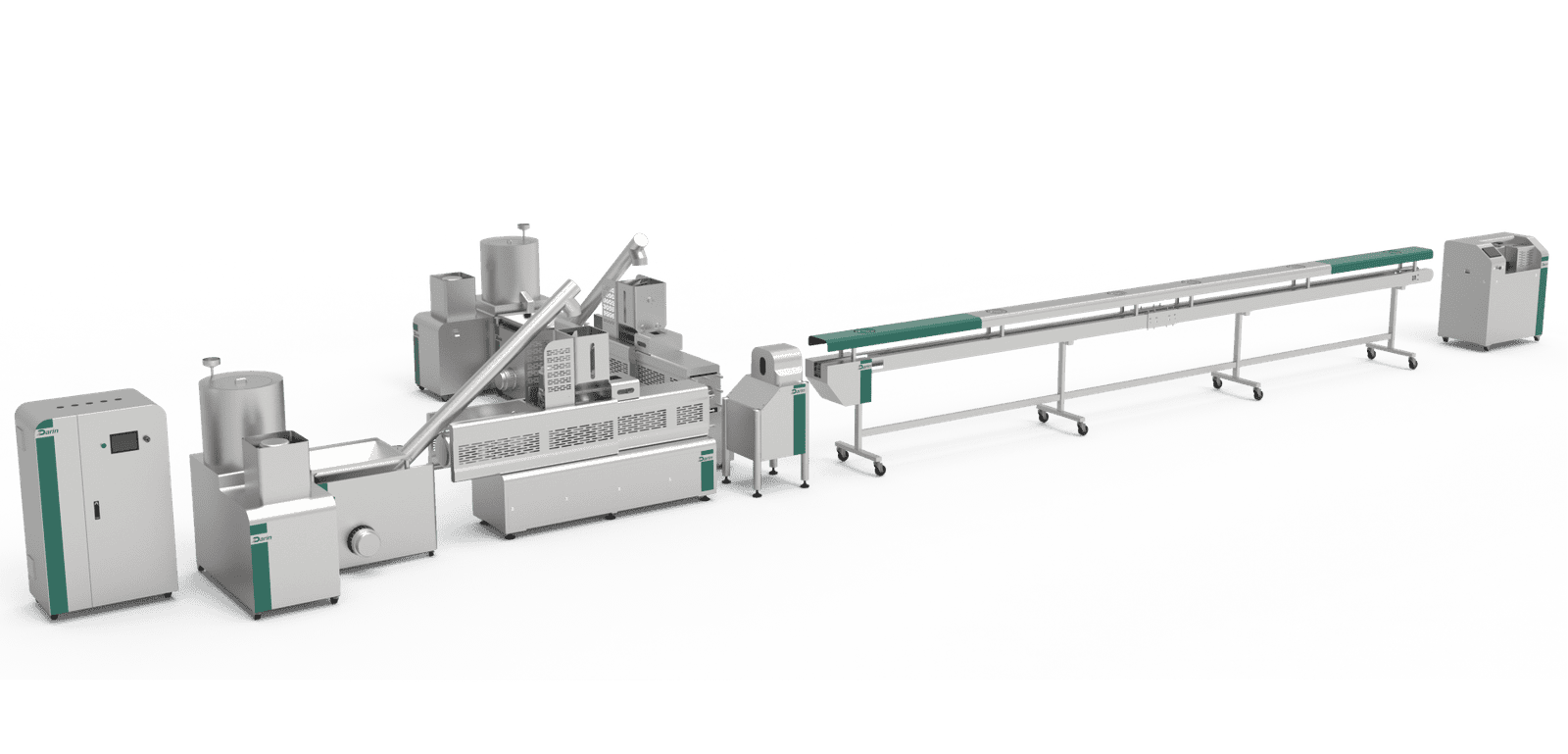
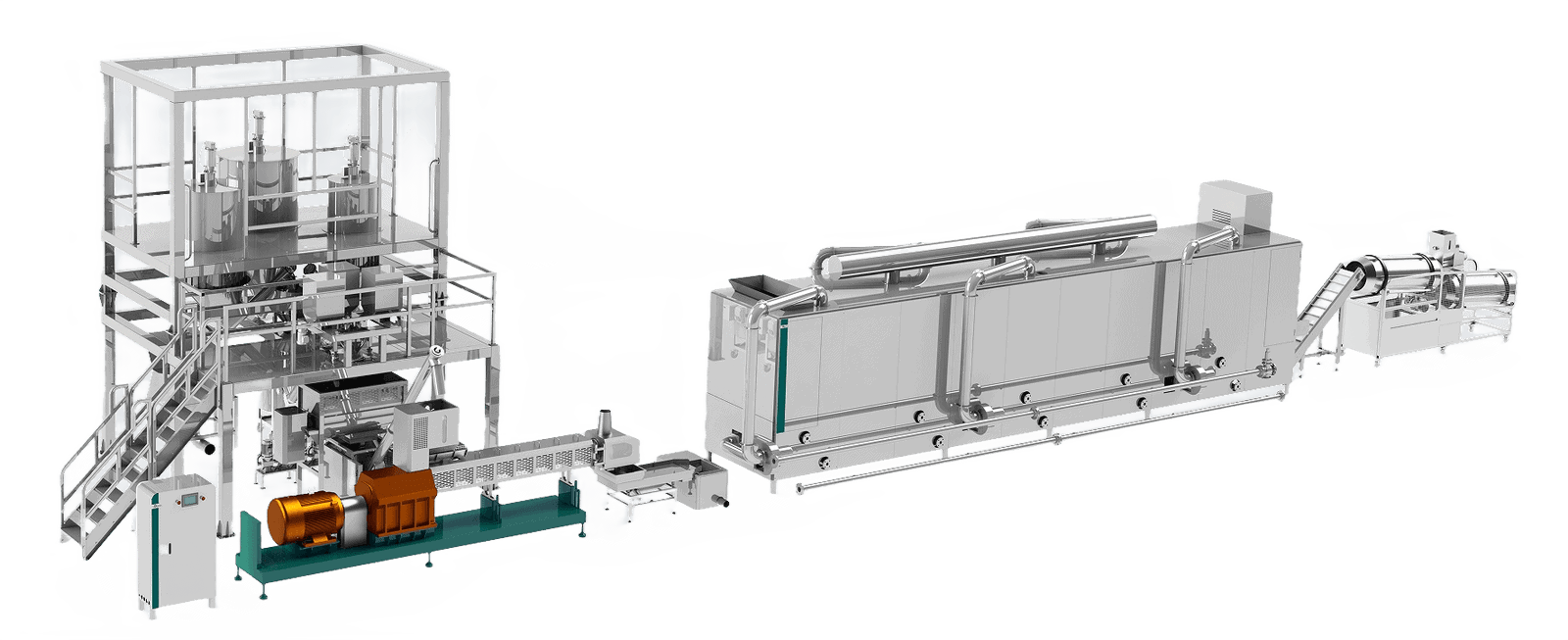
The global pet food industry is expanding rapidly, driven by rising pet ownership, humanization of pets, and the demand for diverse, nutritious products. Yet, many manufacturers struggle with inconsistent product quality, inefficient production, and costly downtime due to outdated equipment or fragmented processing systems. These challenges can lead to lost revenue, inability to meet market demands, and increased regulatory risks.
The solution lies in a modern, automated dog food production line — an integrated system that transforms raw ingredients into finished products efficiently, safely, and at scale. By combining advanced processing technology, precise recipe control, and continuous operation, these lines allow manufacturers to meet diverse product requirements, from dry kibble to wet canned food, semi-moist products, and treats, all while ensuring food safety and optimizing operational costs.
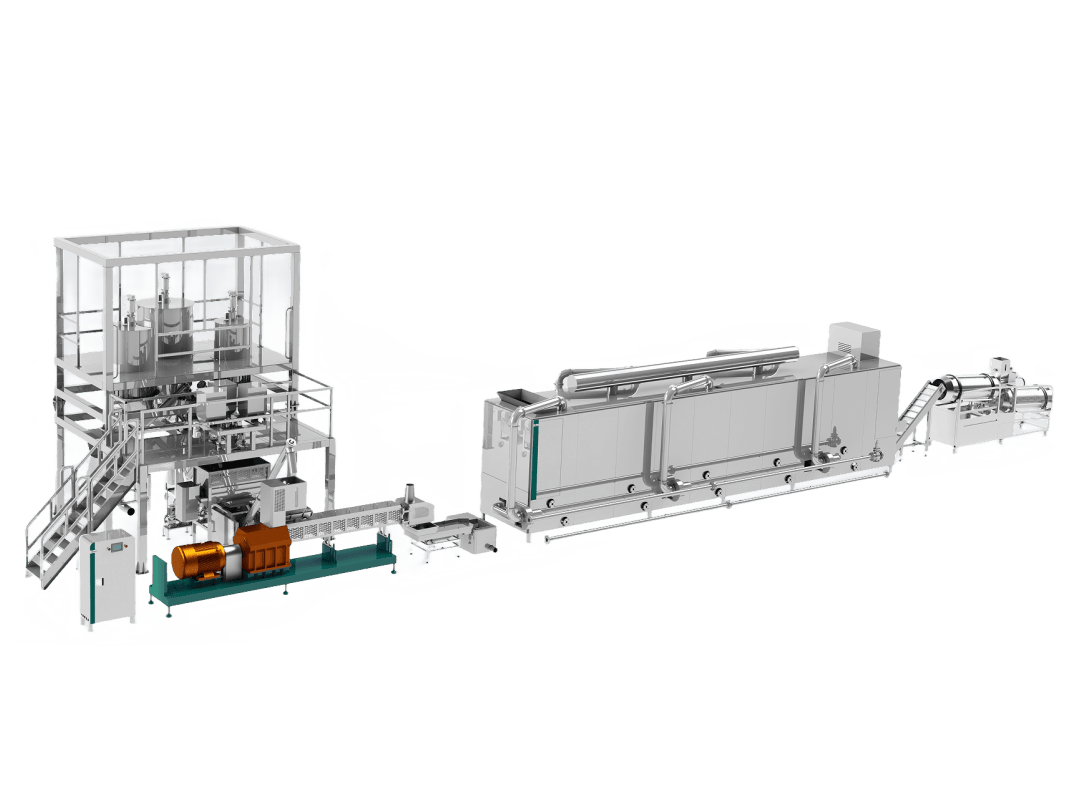
A dog food production line is an integrated system of machinery and processes that converts raw materials — such as meats, grains, vegetables, and supplements — into finished pet food products. The process includes raw material handling, grinding, mixing, cooking (via extrusion or retort), shaping, drying or sterilizing, coating, cooling, and packaging. By adjusting formulation, moisture, temperature, and machine settings, a single production line can produce multiple product types to serve different market segments.
In this in-depth guide, we will explore every stage of dog food production, the global market landscape, the technologies involved, and how Darin Machinery offers industry-leading solutions to maximize efficiency, product quality, and profitability.
Dog food production lines are only capable of producing one type of dog food.False
Modern dog food production lines, especially those using twin-screw extrusion technology, can produce multiple product types including dry kibble, semi-moist food, and specialty treats by adjusting formulation, moisture, and processing parameters.
Chapter 1 – Introduction to Dog Food Production Lines
Dog food production lines are the backbone of the commercial pet food industry, designed to produce large volumes of consistent, high-quality products while meeting strict safety and nutritional standards. Unlike standalone machines, a production line is a coordinated system where each stage is optimized to feed seamlessly into the next, ensuring continuous flow, minimal waste, and repeatable results.
1.1 Product Diversity and Market Demand
Modern dog food production lines are capable of producing:
- Dry kibble: The most common form, with low moisture (8–10%) for long shelf life.
- Wet canned food: Moisture-rich products (70–80%) with high palatability.
- Semi-moist food: Soft, chewy products (25–35% moisture) often used as treats or meal enhancers.
- Specialty treats: Baked biscuits, jerky, dental chews, and functional snacks.
Manufacturers choose line configurations based on their product mix, target markets, and growth plans. For example, a company aiming to export globally may opt for a multi-product line to meet varying consumer preferences in different regions.
1.2 Typical Plant Sizes and Capacities
Dog food production lines range from small-scale (300–500 kg/h) for boutique brands to large industrial plants (5,000+ kg/h) serving international markets. The scalability of modern lines means manufacturers can start with a modest capacity and expand as demand grows — a common strategy among emerging market producers.
1.3 Core Equipment in a Dog Food Production Line
| Equipment | Function | Capacity Range | Example from Darin Machinery |
|---|---|---|---|
| Raw material silos | Bulk storage of dry ingredients | 1–100 tons | Stainless steel silo with auger feed |
| Grinder/Mill | Reduces particle size for uniform mixing | 500–2,000 kg/h | Darin hammer mill |
| Mixer | Blends ingredients evenly | 500–5,000 kg/batch | Horizontal ribbon mixer |
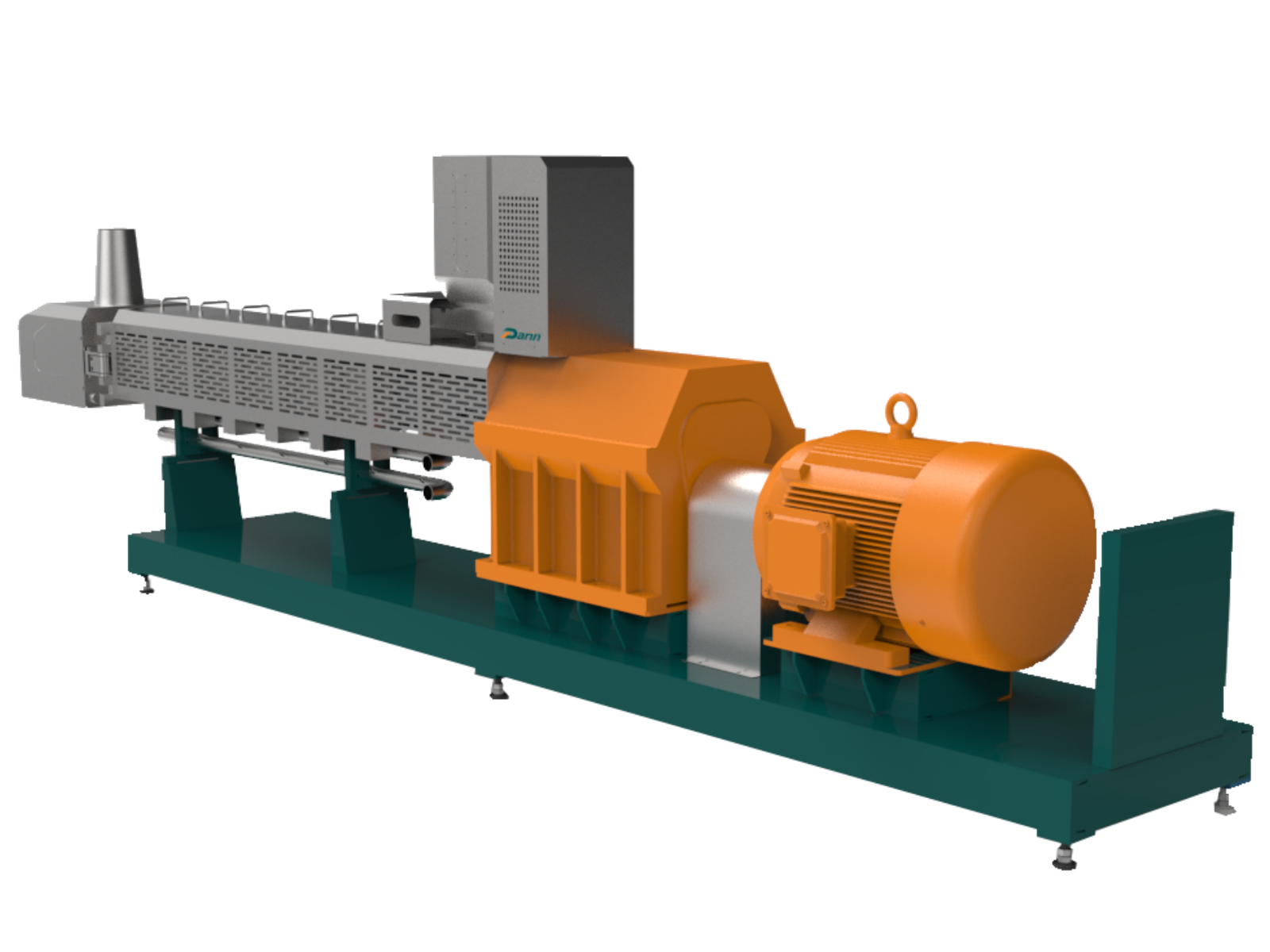
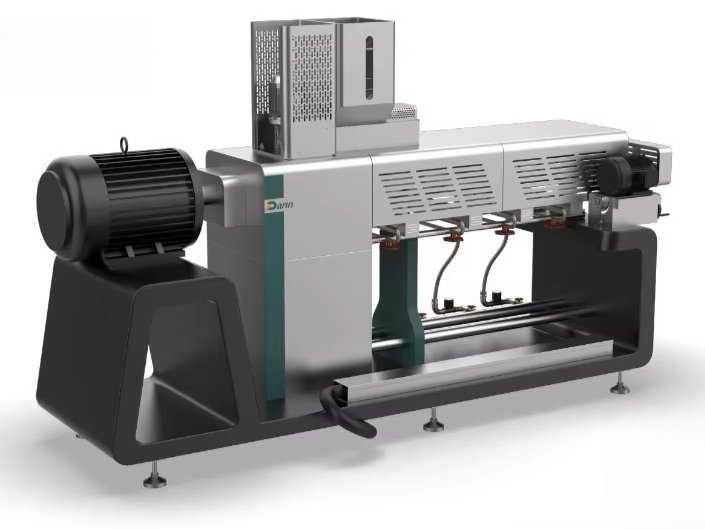
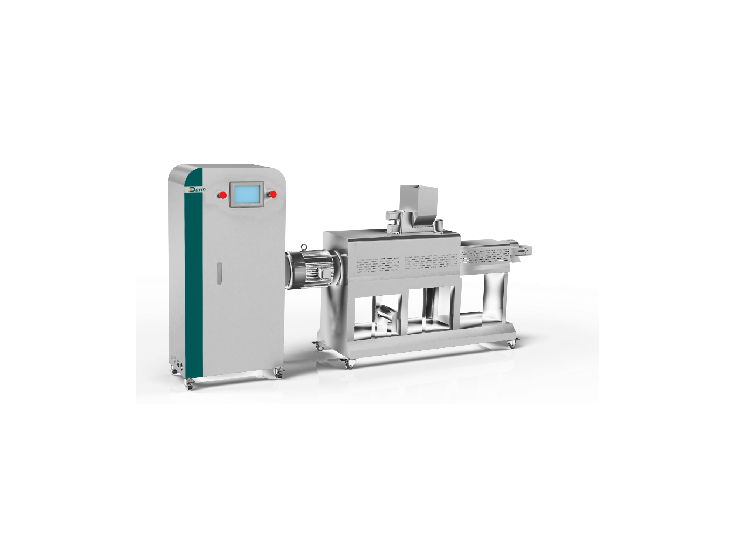
| Extruder / Cooker | Cooks and shapes product | 100–5,000 kg/h | Darin twin-screw extruder |
| Dryer / Retort | Reduces moisture or sterilizes | 500–6,000 kg/h | Multi-layer belt dryer |
| Coater | Applies fats/flavors | 300–3,000 kg/h | Drum or vacuum coater |
| Cooler | Stabilizes product temperature | Matches dryer capacity | Counterflow cooler |
| Packaging machine | Bags/cans finished product | Up to 30 bags/min | Automatic bagger |
Chapter 2 – Global Market Analysis (2025–2035)
The global dog food market is poised for sustained growth, both in monetary value and production volume.
| Year | Global Market Value (USD Bn) | Global Production Volume (Million Tons/Year) |
|---|---|---|
| 2025 | 92.5 | 28.3 |
| 2030 | 124.8 | 37.6 |
| 2035 | 158.4 | 45.9 |
- CAGR (2025–2035): \~5.7% in value, \~5.1% in volume.
- Dry kibble accounts for \~65% of volume but wet and treat segments are growing faster.
- Asia-Pacific is the fastest-growing region, driven by urbanization and pet humanization trends.
Market Drivers:
- Increased pet ownership in emerging economies
- Demand for premium and functional pet foods
- Rise of private-label production contracts
- Advances in automation and food safety compliance
Market Challenges:
- Fluctuating raw material prices
- Stringent regulatory requirements
- Environmental concerns over energy and water usage

Chapter 3 – Step-by-Step Process for Dog Food Production
3.1 Dry Dog Food (Kibble) Process Flow
[Raw Material Storage] --> [Grinding] --> [Mixing] --> [Extrusion Cooking] --> [Drying] --> [Coating] --> [Cooling] --> [Packaging]- Ingredient Preparation – Raw materials are cleaned, weighed, and staged for processing.
- Grinding – Ensures particle uniformity for even cooking.
- Mixing – Combines base ingredients with vitamins, minerals, and functional additives.
- Extrusion Cooking – Cooks under pressure, shapes via dies.
- Drying – Reduces moisture to \~8–10% for stability.
- Coating – Applies fats and palatants for flavor and energy.
- Cooling – Prevents condensation in packaging.
- Packaging – Automated filling into bags with nitrogen flushing if required.
3.2 Wet Dog Food (Canned) Process Flow
[Meat/Vegetable Prep] --> [Grinding] --> [Mixing with Gravy] --> [Can Filling] --> [Retort Sterilization] --> [Cooling] --> [Labeling/Packaging]- Uses high-moisture recipes for palatability.
- Retort sterilization ensures shelf stability without refrigeration.
3.3 Semi-Moist Dog Food Process Flow
[Ingredient Prep] --> [Mixing with Humectants] --> [Forming] --> [Pasteurization] --> [Packaging]- Soft texture achieved via humectants and controlled moisture retention.
3.4 Dog Treats Process Flow
[Ingredient Prep] --> [Extrusion/Baking] --> [Drying or Cooling] --> [Coating (Optional)] --> [Packaging]- Flexible lines can produce biscuits, jerky, or dental chews by changing dies or baking profiles.
Chapter 4 – Core Technologies & Working Principles
Modern dog food production lines rely on a combination of mechanical, thermal, and automation technologies to achieve consistent product quality, efficiency, and safety. The choice of technology determines not only the type of products a plant can produce, but also its energy use, throughput, and flexibility.
4.1 Extrusion Technology (The Heart of Dry and Semi-Moist Production)
Extrusion cooking is the most widely used method for producing dry kibble and many treats.
Working Principle:
- Ingredients are fed into the extruder barrel via a controlled feeder.
- Twin-screw extruders (such as Darin’s DSE Series) use two intermeshing screws to convey, mix, shear, and cook the material under pressure and temperature.
- Cooking occurs due to a combination of steam injection, mechanical shear, and frictional heat.
- As the cooked dough exits the die, sudden pressure drop causes it to expand, creating the desired texture.
- Rotary knives cut the extrudate to length.
Advantages of Twin-Screw Technology:
- Better mixing and cooking uniformity than single-screw.
- Flexibility to produce multiple shapes and recipes.
- Handles a wider range of raw materials, including high-fat and high-fiber recipes.
- Faster changeovers for product variety.
4.2 Retort Cooking (Essential for Wet Food)
Wet food production relies on retort sterilization to ensure shelf stability without refrigeration.
- Sealed cans or pouches are placed in a retort chamber.
- Heated to 121°C under pressure for a set time (often 30–90 minutes).
- This kills all pathogens and spores while preserving texture and flavor.
Darin Retort Systems: Designed with energy recovery features and programmable cycles for different product viscosities.
4.3 Drying Systems
Drying is critical for dry kibble, treats, and some semi-moist products.
- Multi-layer belt dryers are most common, moving product slowly through heated zones.
- Moisture is reduced to safe levels (often <10%) to prevent mold growth.
- Modern dryers include heat recovery and precise airflow control.
4.4 Coating Systems
Two main types:
- Drum Coaters – rotate product while spraying oil/powder.
- Vacuum Coaters – draw coating deep into the product’s pores, ideal for fat-soluble vitamins and flavor enhancers.
Chapter 5 – Machinery Selection & Technical Parameters
Choosing the right configuration depends on capacity needs, product range, and budget. Darin Machinery offers modular systems that can be scaled up or modified over time.
5.1 Capacity and Cost Table
| Capacity | Extruder Power (kW) | Dryer Size | Estimated Line Cost (USD) |
|---|---|---|---|
| 300 kg/h | 37 | 5 m length | \$60,000–\$80,000 |
| 1,000 kg/h | 75 | 8 m length | \$120,000–\$150,000 |
| 3,000 kg/h | 132 | 12 m length | \$250,000–\$320,000 |
| 5,000 kg/h | 200 | 15 m length | \$380,000–\$500,000 |
5.2 Capacity–Cost Curve
Interpretation:
- Smaller lines have lower capital cost but higher per-unit production cost.
- Mid- to large-scale lines (3–5 t/h) offer better ROI due to economies of scale.
- For new entrants, starting at 1 t/h is common, with planned expansion modules.
Chapter 6 – Energy Efficiency & Sustainability
Energy costs can make up 20–30% of total production expenses. Modern lines, including those from Darin Machinery, integrate energy-saving designs:
- Variable Frequency Drives (VFDs) on motors to optimize power draw.
- Heat Recovery Systems in dryers and retorts.
- LED Lighting and Low-Standby PLC Modes in control systems.
Energy Use Benchmarks per Ton of Dry Kibble:
- Extrusion: 90–120 kWh/ton
- Drying: 200–250 kWh/ton (electric) or 16–20 m³ gas/ton
- Coating: 10–15 kWh/ton
Environmental Sustainability Practices:
- Using locally sourced ingredients to reduce transport emissions.
- Implementing water recirculation in steam systems.
- Recycling packaging materials where possible.
Chapter 7 – Plant Layout, Automation & Industry 4.0
A well-designed plant layout ensures smooth material flow and minimizes cross-contamination risks.
7.1 Typical Layout for a Dry Kibble Plant
- Raw Material Storage – silos, bins, cold rooms for meats.
- Grinding & Mixing Area – adjacent to raw storage for short conveyance lines.
- Extrusion Zone – separated for safety and noise control.
- Drying/Coating/Cooling Area – climate-controlled to prevent condensation.
- Packaging Hall – clean, isolated from production dust.
- Warehouse – for finished goods.
ASCII Layout (Simplified):
[Raw Storage] --> [Grinding/Mixing] --> [Extrusion] --> [Drying] --> [Coating] --> [Cooling] --> [Packaging] --> [Warehouse]7.2 Automation & Industry 4.0 Features
- PLC Control Systems – centralizes operation and monitors every machine.
- SCADA Integration – for real-time performance tracking.
- Predictive Maintenance Alerts – using vibration and temperature sensors.
- Recipe Management – automated changeovers for different SKUs.
- Remote Access – allowing Darin technicians to support clients worldwide.
Chapter 8 – Case Studies (Darin Machinery Projects)
Real-world examples demonstrate how the right production line can transform a pet food business.
8.1 Case Study 1 – 3,000 kg/h Dry Kibble Line in Europe
Client Profile: A large private-label pet food producer supplying multiple supermarket chains.
Challenge: Replace aging equipment to meet EU safety standards and expand capacity by 40% without increasing labor.
Solution: Darin Machinery designed and installed a 3,000 kg/h twin-screw extrusion line with automated dosing, PLC control, and energy recovery in the dryer.
Results:
- 18% reduction in energy costs per ton.
- Consistent kibble size with ±1 mm variation.
- Payback period: 2.8 years.
8.2 Case Study 2 – Multi-Product Line in Asia
Client Profile: Mid-sized brand entering premium pet food market.
Challenge: Flexibility to produce kibble, semi-moist, and treats on a single line.
Solution: Darin supplied a multi-function extruder with quick-change dies and modular post-processing equipment.
Results:
- Product changeover in under 2 hours.
- Exported to 5 new markets within the first year.
8.3 Case Study 3 – Wet Food Retort Line in South America
Client Profile: Canned food manufacturer diversifying into pet food.
Challenge: Achieve shelf-stable wet food with gourmet texture.
Solution: Darin installed a retort-based wet food line with programmable sterilization profiles and gravy-filling system.
Results:
- 100% compliance with export market regulations.
- Increased production by 60% in first year.
Chapter 9 – ROI, Payback Period & Capacity–Cost Curves
9.1 ROI Table
| Capacity | Investment (USD) | Annual Profit (USD) | Payback (Years) |
|---|---|---|---|
| 1 ton/h | \$150,000 | \$85,000 | 1.76 |
| 3 ton/h | \$300,000 | \$210,000 | 1.43 |
| 5 ton/h | \$450,000 | \$390,000 | 1.15 |
9.2 ROI Curve
Insights:
- Higher capacity lines have shorter payback periods due to economies of scale.
- Profitability is sensitive to energy and raw material costs — energy-efficient equipment from Darin helps maintain margins.
Chapter 10 – Competitor Benchmarking Table (Darin vs. Global Brands)
| Brand | Product Range | Energy Use | Automation | Price/Capacity Ratio | Maintenance Needs |
|---|---|---|---|---|---|
| Darin Machinery | Dry/Wet/Semi/Treat | Low | High | Excellent | Low |
| Brand A (EU) | Dry only | Medium | High | Medium | Medium |
| Brand B (US) | Dry/Wet | Medium | Medium | High | High |
| Brand C (CN) | Dry/Treat | High | Low | Low | High |
Why Darin Leads:
- Versatility: One line for multiple product types.
- Efficiency: Lower kWh/ton usage.
- Service: Global remote support + local partners.
- ROI: Competitive CAPEX with low OPEX.
Chapter 11 – Regulatory Compliance (FDA, EU, ISO, CE)
11.1 United States (FDA)
- Compliance with CFR Title 21 for pet food.
- HACCP plans and preventive controls mandatory.
11.2 European Union
- EC Regulation 183/2005 on feed hygiene.
- CE marking for machinery under the Machinery Directive.
11.3 International Standards
- ISO 9001 for quality management.
- ISO 22000 for food safety management.
11.4 Darin’s Compliance Advantage
- All equipment designed for easy cleaning and sanitation.
- CE and ISO certifications standard.
- Optional USDA-compliant stainless steel upgrades for US clients.
Dog food production lines are the technological backbone of the global pet food industry, enabling consistent quality, safety, and scalability. From dry kibble to wet gourmet meals, these systems combine mechanical engineering, thermal processing, and advanced automation to deliver products that meet both consumer expectations and regulatory requirements.
With decades of experience, Darin Machinery offers solutions that outperform competitors in versatility, efficiency, and return on investment. Whether you are upgrading an existing plant or building a new facility, Darin can design, install, and support a line tailored to your capacity, recipes, and growth ambitions.
Call to Action
Ready to upgrade or build your pet food plant?
Contact Darin Machinery for customized dog food production lines that meet your capacity, recipe, and budget needs — whether you produce dry kibble, wet food, semi-moist, or premium treats.
📧 Email: darin4@darin.cn
🌐 Website: www.petreatsmachine.com