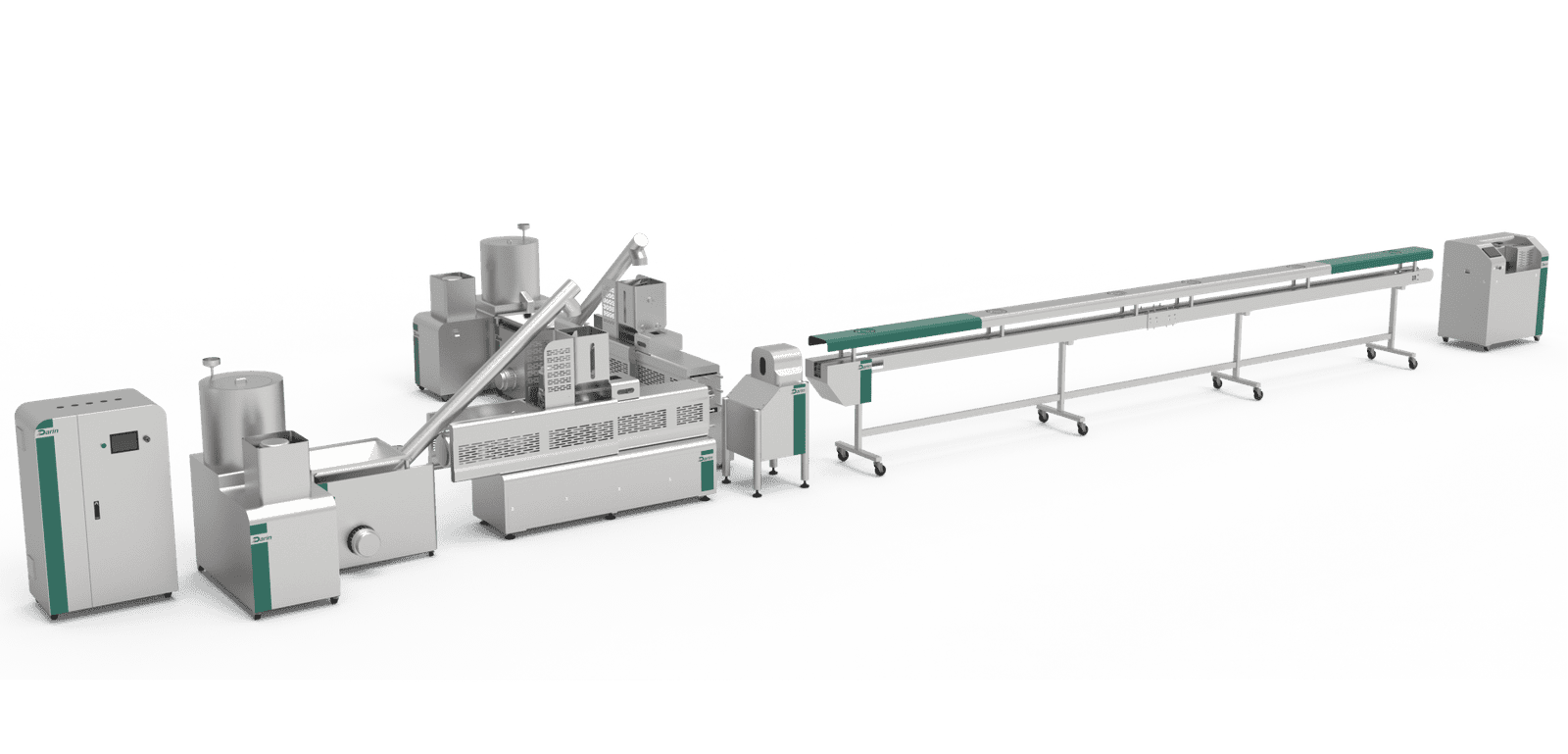
Manufacturers of dog chews and pet dental treats often face the same production challenge: as order volumes grow, manual feeding, stick placement, tray arrangement, and product counting can become bottlenecks. These tasks take time, depend on operator experience, and can make it difficult to keep product appearance consistent from batch to batch.
An automatic dog chew production line connects key processing stages—from ingredient preparation and extrusion to cooling, cutting, drying, and product arrangement for packaging. Instead of relying on workers to move and position every product by hand, the line uses connected equipment to keep products moving through the process with less repetitive manual handling.
Darin Machinery provides automatic pet chew processing solutions for manufacturers that want to improve production flow, reduce labor pressure, and prepare for larger orders. This article explains how an automatic dog chew production line works, what problems it can address, and which technical details buyers should confirm before choosing a system.
What Is an Automatic Dog Chew Production Line?
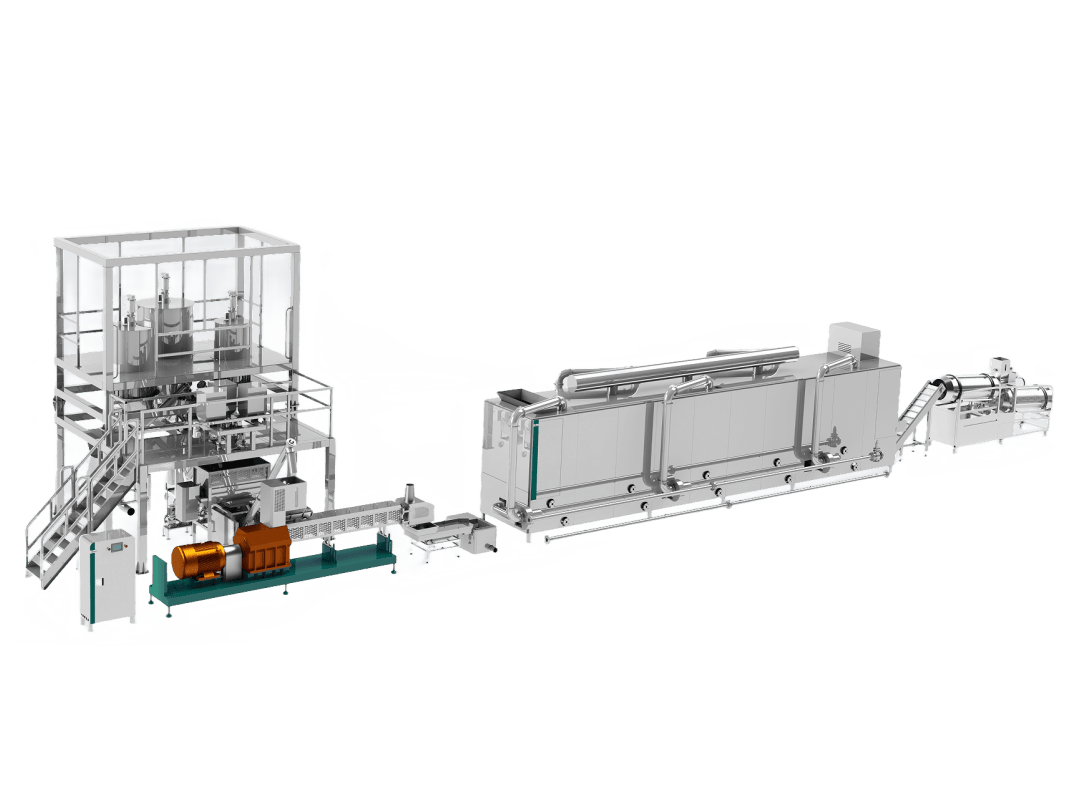
An automatic dog chew production line is an integrated system for processing pet chew products. Depending on the product recipe and shape, the line can include ingredient mixing, extrusion, cooling, cutting, conveying, oven drying, and automatic arranging or counting before packaging.
The purpose is not simply to automate one machine. It is to connect multiple operations so that products can move from one stage to the next in a more continuous and controlled way. For a factory producing dog chew sticks or dental chews, this can reduce the need for workers to repeatedly pick up products, place them in position, arrange them on trays, and prepare them for the next stage.
The exact configuration depends on the chew formulation, dimensions, moisture level, target output, and packaging method. Buyers should therefore evaluate the complete process rather than comparing machines by name alone.
How Does the Production Process Work?
A typical configuration of Darin’s automatic dog chew production line includes the following stages.
1. Ingredient Preparation and Mixing
Powdered and liquid ingredients are prepared and mixed to create a uniform feed material. Consistent mixing is an important starting point because variation in the material can affect extrusion and the appearance of the finished chew. Ingredient handling and recipe requirements should be confirmed for each product.
2. Feeding and Extrusion
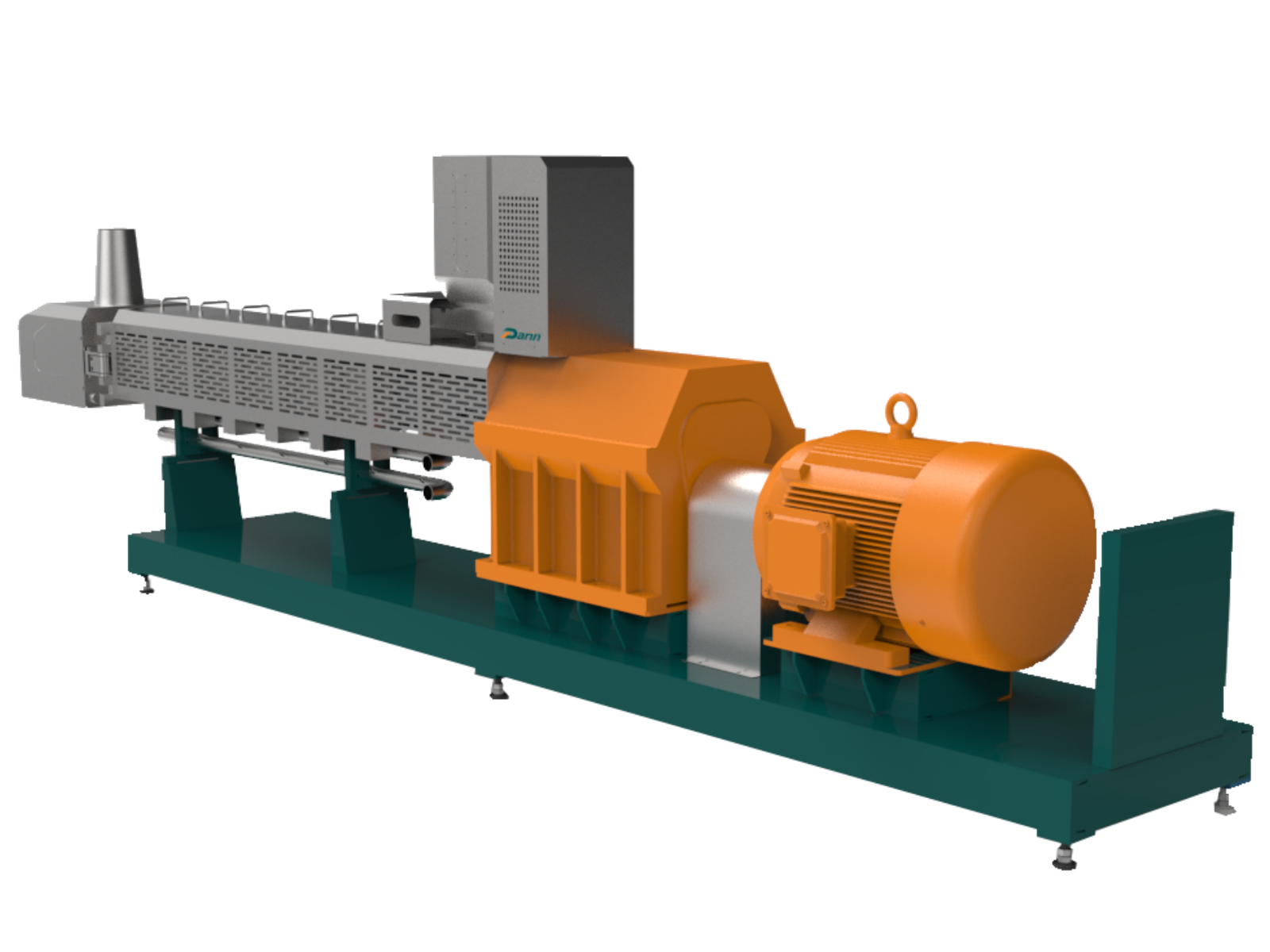
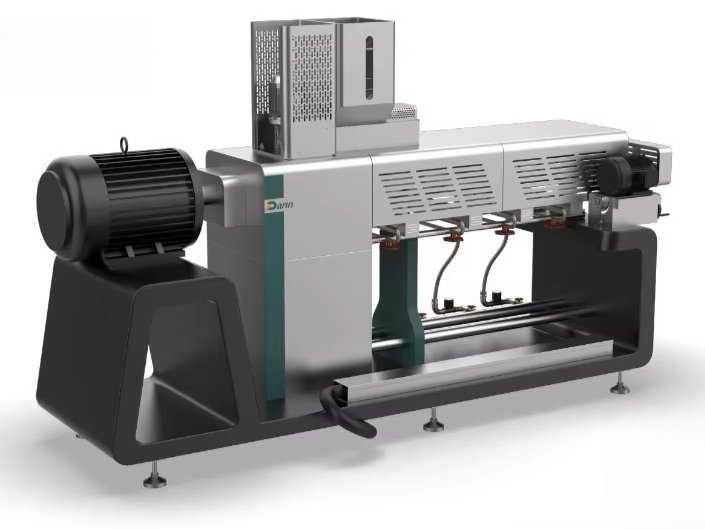
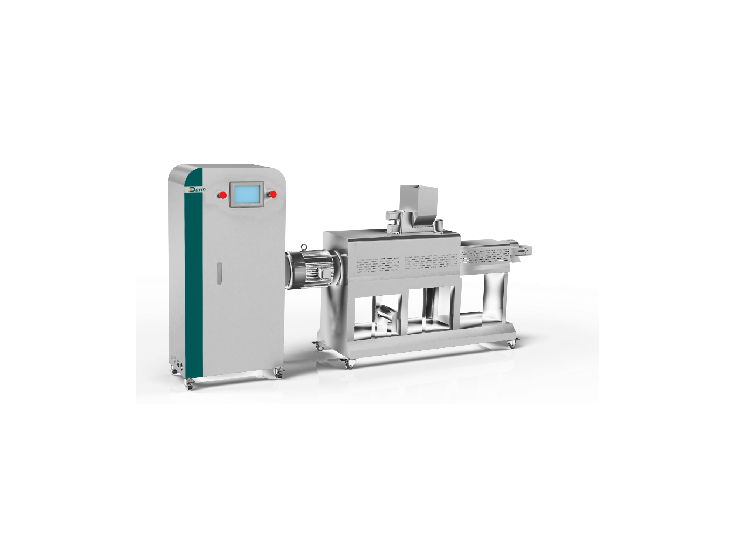
The prepared material is fed into an extruder, where it is formed into the required shape. The extrusion setup needs to match the product formulation and dimensions. When discussing a project with an equipment supplier, manufacturers should provide product samples, target sizes, and details of the material being processed.
3. Cooling
After forming, the product passes through a cooling stage. Cooling helps prepare the product for downstream handling and cutting. The required cooling conditions depend on the product and process, so they should be verified during product testing.
4. Cutting to Length
The formed product is cut to the specified length. Consistent cutting helps manufacturers maintain product-size requirements and reduces the need for manual correction later. Actual dimensional accuracy depends on the product, equipment setup, and operating conditions.
5. Automatic Conveying to the Oven
A telescopic conveying system transfers products toward the oven feeding section. This connection reduces the need to carry products manually between stages and helps establish a more continuous workflow.
6. Oven Drying
The products enter an oven for drying. Drying settings must be selected according to the recipe, product dimensions, and desired final moisture characteristics. Manufacturers should confirm the suitable time and temperature through testing rather than assuming one setting works for every chew product.
7. Automatic Arranging and Counting Before Packaging
At the downstream end, an automatic rotary arranging system organizes and counts products for the packaging stage. Regular arrangement can reduce the need for workers to sort products again by hand. Operators can inspect the output and remove products that do not meet the agreed appearance requirements before packaging.
What Problems Can Automation Solve?
Manual Placement Can Restrict Production Output
When workers feed and position chew sticks one by one, production speed is limited by manual handling. The line may struggle to keep pace when orders increase, and delivery schedules can become harder to maintain.
Connected conveying, automated feeding, and downstream arranging help reduce these handling bottlenecks. By linking the main production stages, manufacturers can reduce interruptions caused by moving products manually between machines.
For factories receiving large orders, improving the connection between processing, drying, and packaging can be just as important as increasing the speed of an individual machine.
Inconsistent Product Positioning Can Affect Appearance
Manual positioning and handling can contribute to differences in product length, shape, or meat wrapping thickness where the product includes a meat coating or wrap.
A more standardized process can help improve repeatability, although the final result still depends on raw materials, recipes, machine settings, and quality control.
For OEM and ODM pet treat manufacturers supplying multiple brands, consistent product appearance can be particularly important because finished products must meet the specifications agreed upon with each customer.
Repetitive Work Increases Labor Pressure
Repeatedly loading, placing, arranging, and counting products is tiring work. Factories may also face recruitment, training, and staff turnover challenges.
Automation can reduce the number of repetitive handling tasks and allow operators to supervise equipment and inspect products instead. The actual staffing level depends on the plant layout and the level of automation selected.
Manual Contact Makes Hygiene Management More Difficult
Reducing unnecessary hand contact can support more consistent hygiene practices in a pet food processing environment.
Automation does not by itself guarantee compliance with food-safety or export requirements. Equipment design, cleaning procedures, material handling, and the factory’s own quality system must also meet the applicable requirements.
Manual Counting and Tray Arrangement Add Extra Work
If products are placed randomly or counted by hand, workers may need to reorganize them before packaging.
Automatic arranging and counting can make product presentation more consistent and help the packaging stage receive products in a more orderly flow. This reduces the need for repeated sorting and handling between production and packaging.
Key Technical Specifications of Darin’s Automatic Dog Chew Production Line
The following figures are the reference specifications supplied for this Darin production line. Final specifications should be confirmed against the selected configuration and the customer’s product requirements.
| Technical item | Reference specification |
|---|---|
| Application | Pet chew and pet treat processing |
| Reference production capacity | Approximately 200 kg/h |
| Installed power | Approximately 120–150 kW |
| Electrical supply | 380 V, 50 Hz, three-phase; customizable according to project requirements |
| Reference footprint | Approximately 25 × 5 × 4.5 m |
| Suggested operators | Approximately 3–5 people |
| Automation scope | Ingredient preparation through conveying, drying, and arranging/counting before packaging |
| Main processing stages | Mixing, extrusion, cooling, cutting, conveying, drying, and automatic arranging |
Production capacity: The reference capacity is approximately 200 kg/h, not a guaranteed output for every product. Actual throughput may vary with the recipe, product size, moisture, drying time, line configuration, and operating conditions.
Installation requirements: The footprint and power requirements should be checked against the factory’s available space, utilities, and installation conditions.
Labor requirements: The indicated staffing level is approximately three to five operators: one or two people for ingredient feeding and the extrusion/cutting section, one for the oven infeed section, and one for the packaging section, depending on the final layout. Operators may still be needed to monitor production and remove products that fail visual inspection.
Example: A Serbian Customer’s Automation Project
A Serbian customer purchased an automated ingredient preparation section, automatic oven feeding, and automatic packaging-related sections. According to the project information provided, these connected sections helped the customer move toward a more automated production process, with only a small number of workers assisting around the equipment.
This example illustrates an important point for manufacturers considering automation: it may be possible to improve a factory step by step, focusing first on labor-intensive or difficult-to-connect operations.
The best project scope depends on the existing equipment, product requirements, available space, and investment plan. The customer example should not be treated as a universal performance guarantee. Before making an investment, manufacturers should review the proposed configuration and confirm the expected output, staffing, product quality, and integration requirements for their own factory.
Who Should Consider an Automatic Dog Chew Production Line?
An automatic dog chew production line may be worth evaluating for the following types of manufacturers:
-
Pet treat manufacturers receiving larger orders: Factories that need a more consistent production flow as order volumes increase.
-
OEM and ODM pet treat manufacturers: Contract manufacturers producing dog chews for multiple brands and working to different customer specifications.
-
Dog dental chew and chew stick producers: Manufacturers looking to reduce manual feeding, stick placement, and product arrangement.
-
Factories experiencing labor shortages: Producers that want to reduce repetitive manual tasks and dependence on operator experience.
-
Manufacturers planning to upgrade existing equipment: Factories seeking to connect extrusion, drying, and packaging into a more integrated production process.
The line is not automatically the right choice for every factory. Smaller producers with low-volume or frequently changing products may need a different level of automation. An equipment supplier should assess the current process and expected production demand before recommending a configuration.
How to Choose the Right Automatic Dog Chew Equipment
Before requesting a quotation, prepare answers to these questions.
- What product do you manufacture?
Share product photos, samples, dimensions, recipe characteristics, and whether the chew is plain, coated, wrapped, or made in another format. These details help the supplier assess whether the proposed extrusion and downstream equipment are suitable. - What production output do you need?
Specify the required kilograms per hour or pieces per minute, as well as the number of operating hours per day. Also clarify whether the target refers to theoretical machine capacity or actual finished products after quality inspection. - What is your current production bottleneck?
Identify whether the main issue is ingredient feeding, manual placement, cutting, oven loading, arranging, counting, or packaging. Knowing where time is lost makes it easier to determine which operations should be automated first. - What utilities and factory space are available?
Confirm the factory layout, electrical supply, ventilation, and installation constraints. The line must fit the available production area and work with the factory’s utilities. - What level of automation do you need?
Decide which existing machines should be retained and which stages need to be connected or automated. A customized solution may be more appropriate than replacing every machine at once. - How will product quality be checked?
Agree on acceptable dimensions, appearance, drying results, and the inspection method for defective products. Product samples and testing should be part of the equipment evaluation process.
Ask the supplier to clarify what is included in the line, which operations still require manual work, how changeovers are handled, and what product tests are needed before final acceptance. A clear scope helps buyers compare proposals on a like-for-like basis.
Frequently Asked Questions
What is the production capacity of Darin’s automatic dog chew production line?
The current reference specification is approximately 200 kg/h. Actual production output depends on the product, recipe, dimensions, drying requirements, and final equipment configuration. Buyers should confirm capacity using their own product requirements.
How many workers are needed to operate the line?
The reference staffing requirement is approximately three to five people. The final number depends on the plant layout, operating practices, inspection requirements, and which sections are automated.
Does the line automate the entire dog chew production process?
The reference configuration connects ingredient preparation, extrusion, cooling, cutting, conveying, oven drying, and automatic arranging/counting before packaging. Operators may still need to monitor the equipment and remove products that do not meet appearance requirements. The exact scope of automation should be confirmed in the quotation.
Can an automatic dog chew production line reduce manual labor?
Yes. Automated conveying, oven feeding, and product arranging can reduce repetitive manual movement and placement. The amount of labor saved depends on the customer’s existing process and the final configuration.
Is the line suitable for every type of dog chew?
Not necessarily. Product formulations, shapes, dimensions, and drying requirements can differ substantially. Manufacturers should send samples and technical details so that the supplier can assess suitability and confirm the configuration.
What information should I provide when requesting a quotation?
Provide your product type, product dimensions, target capacity, current production process, factory space, available electrical supply, and desired level of automation. Product samples, photos, and videos of the existing process can also help the supplier evaluate the project.
Discuss Your Dog Chew Production Requirements with Darin
Choosing an automatic dog chew production line starts with understanding the product and identifying where manual work slows production. An integrated system can connect mixing, extrusion, cooling, cutting, drying, and product arranging to create a more orderly production flow and reduce repetitive handling.
Darin Machinery develops pet treat processing equipment and automated production solutions. To discuss a project, share your product type, target capacity, current production process, and factory constraints. The equipment configuration and technical specifications can then be reviewed against your actual requirements.
Contact Darin Machinery: marketing@darin.cn
Related search terms: Automatic Dog Chew Production Line, Dog Dental Stick Production Line, Automatic Dental Treats Processing Line, Pet Chew Processing Line, Dog Chew Stick Manufacturing Line, Dental Treats Making Machine, Pet Treats Extruder Machine.